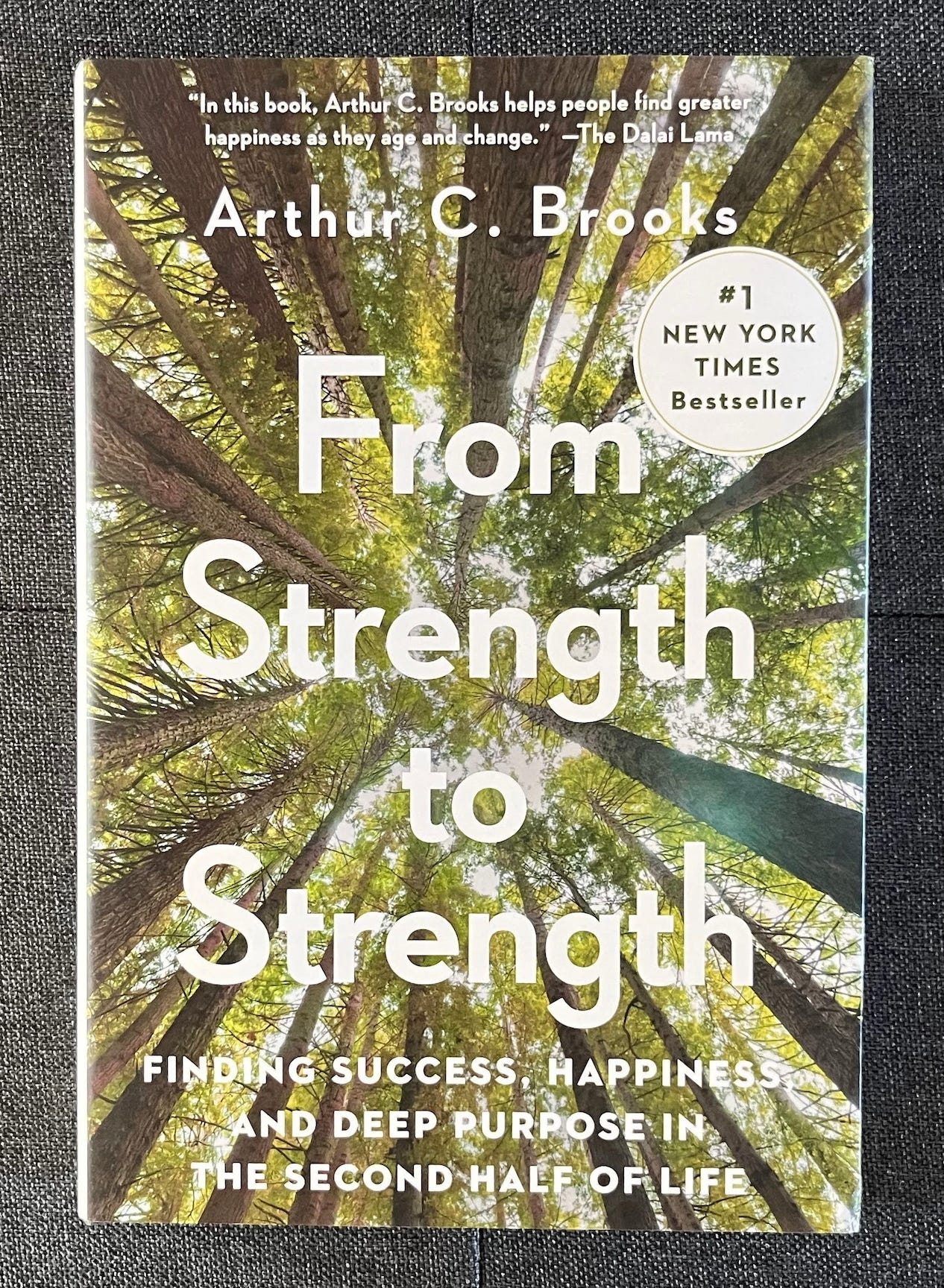
“Hold your success lightly—be ready to change as your abilities change.” The premise of remaining flexible, shifting identity away from achiever mode, and better leveraging current strengths really resonated with me.
I can clearly feel a pull toward how my contributions as a mentor provides the level of fulfillment that I’m aiming for at this stage of my coaching career.
I especially recommend this book if you are entering the second half and searching for the language of transition. As explained below, the concept of “crystallized intelligence” makes for a honest argument in favor of confronting and unlocking this shift head on.
Arthur Brooks’s From Strength to Strength explores how to find purpose and satisfaction as the abilities that brought us early success begin to change. His central argument is that aging can open another period of meaningful contribution if we learn to take advantage of and use different strengths.
The distinction between fluid and crystallized intelligence anchors the book:
Fluid Intelligence
What it means: Reasoning through unfamiliar problems without relying heavily on previous knowledge.
Typical strengths: Quick thinking, flexible reasoning, and solving novel problems.
How it changes: Generally stronger earlier in adulthood and more vulnerable to age-related decline.
Brooks’s career emphasis: Generating solutions and making individual breakthroughs.
Crystallized Intelligence
What it means: Applying accumulated knowledge, experience, and learned understanding.
Typical strengths: Recognizing familiar patterns, explaining ideas, and putting knowledge into context.
How it changes: Can remain strong or grow through much of adulthood as knowledge accumulates.
Brooks’s career emphasis: Teaching, mentoring, advising, and helping others develop.
A Second Curve
Brooks describes the opportunity as moving toward a “second curve” or making greater use of experience as some earlier abilities become less dependable.
In his coaching example, the contribution shifts toward recognizing which questions deserve attention and helping others understand them. These are broad patterns, not a fixed timetable or two mutually exclusive types of person.
The book’s other main points build on that transition:
- Loosen your attachment to achievement. When professional success becomes your identity, changing performance can feel like losing yourself. Brooks encourages exploring a wider foundation for self-worth.
- Recognize the trap of success addiction. Recognition can create an endless need for the next accomplishment. Pride and fear can keep people chasing rewards that no longer provide lasting satisfaction.
- Reduce your wants as well as pursuing your goals. Brooks argues that satisfaction depends partly on managing desire. Constantly raising your expectations makes it difficult to appreciate what you already have.
- Invest deliberately in relationships. Close friendships and loving connections require effort and attention. A network built around professional usefulness cannot fulfill every need for belonging.
- Make room for service and spiritual depth. Helping others, loosening attachment to status, and exploring meaning beyond career achievement become central priorities.
- Accept openness and finitude. Acknowledging weakness and mortality can clarify priorities and make deeper connection possible.
For myself, shifting from achiever to mentor fits Brooks’s framework closely. My interpretation: years of experience become especially valuable when they help you listen carefully, notice patterns, ask useful questions, and develop another person’s judgment.
Those practices allow me a meaningful way to keep growing while contributing to the professional development of the next generation.