As my plane descended toward Nassau, Bahamas, I gazed across a breathtaking expanse of turquoise waters and scattered islands. Centuries ago, these same waters were sailed by notorious Caribbean pirates who amassed fortunes, challenged empires, and risked everything in pursuit of adventure and freedom—aye, savvy mates!
I couldn’t help wondering: What did these notorious outlaws of the sea understand about success that modern men might have forgotten?
For me, the question was personal.
Growing up with a family legend of pirate ancestry, I’ve always been fascinated by these unconventional characters. Visiting Nassau, once a notorious pirate haven, reignited my curiosity about my family’s past and the wisdom that might be buried beneath centuries of pirate lore.
After all, what could a ruthless pirate, stolen treasure, and a man rumored to have married 14 women possibly teach us about business, life, and romance?
Perhaps more than we’d care to admit.
I’m certainly not suggesting we resurrect piracy as a legitimate business model. Plundering ships and terrorizing merchants are hardly recipes for modern success.
But look beyond the criminality and Hollywood mythology, and intriguing lessons emerge about reputation, risk, independence, attraction, and self-command.
That curiosity led me to Edward Teach, better known as Blackbeard, one of the most infamous figures of the Golden Age of Piracy.
More than 300 years ago, Blackbeard commanded ships, cultivated a terrifying reputation, and challenged the established order. His extraordinary rise and violent downfall offer lessons that remain surprisingly relevant.
Here are five lessons from Blackbeard’s legend that modern men can apply legally and ethically.
1. Reputation Is Power: Become Impossible to Ignore
Long before personal branding and social media, Blackbeard understood the power of perception.
Historical accounts describe an imposing figure with a dark beard who sometimes placed slow-burning fuses around his face, creating a terrifying spectacle of smoke during confrontations.
Imagine encountering that sight aboard a merchant ship in the early 1700s.
Blackbeard understood that reputation could accomplish what brute force might otherwise require. His fearsome image became part of his strategy.
Today’s entrepreneurs operate in a different world, but the principle remains relevant.
Your reputation often enters the room before you do.
A strong personal or business brand establishes credibility, attracts opportunities, and distinguishes you from competitors.
But attention alone isn’t enough. A memorable image must be supported by competence, integrity, and results.
The objective isn’t simply to become famous. It’s to become known for something valuable.
The takeaway: Don’t just compete for attention. Build a reputation that commands respect and earns trust.
2. Fortune Favors the Bold—but Rewards the Prepared
Blackbeard didn’t become infamous by waiting for ideal conditions.
He operated in a dangerous world of shifting alliances, uncertain opportunities, and extraordinary risks. His willingness to act decisively contributed to his notoriety.
But his story also demonstrates the danger of recklessness. His career ended violently in 1718.
In business, playing it safe can sometimes be the riskiest decision of all.
Launching a company, pursuing an unconventional opportunity, or reinventing your career requires a willingness to navigate uncertainty.
Yet boldness without preparation isn’t courage. It’s gambling.
Successful entrepreneurs understand the difference between calculated risk and blind ambition. They evaluate opportunities, prepare for setbacks, and recognize when the potential reward justifies the exposure.
Blackbeard’s story reminds us that opportunity favors action, but lasting success demands judgment.
The takeaway: Have the courage to pursue opportunity and the discipline to survive the consequences.
3. Freedom Is the Greatest Treasure
Ask a man what he wants from success, and he’ll probably mention money, influence, recognition, or security.
Ask him why, and eventually the conversation leads somewhere deeper.
Freedom.
Freedom to control his time. Freedom to pursue meaningful work. Freedom to travel, create, and build something of his own. Freedom to protect the people he loves.
Blackbeard rejected conventional authority, although his independence came at the expense of others and ultimately proved short-lived.
His story nevertheless challenges us to examine our own definitions of success.
Consider the executive earning an extraordinary income but having no time for family. Or the entrepreneur who builds a thriving company only to discover that the business controls every waking hour.
Is that really success?
Wealth without independence can become an expensive form of captivity.
Real freedom isn’t the absence of responsibility. It’s the ability to choose which responsibilities deserve your time, energy, and commitment.
Money can provide options. Influence can open doors. But neither guarantees a life worth living.
The takeaway: The greatest treasure isn’t gold, power, or fame. It’s the freedom to command your own life.
4. Fourteen Wives? The Difference Between Conquest and Commitment
Blackbeard wasn’t merely famous for capturing ships. According to popular legend, he also had quite a history of capturing hearts.
Some accounts claim the notorious pirate had as many as 14 wives.
The number remains historically disputed, with surviving records documenting far fewer marriages. Still, the legend offers a provocative starting point for discussing romance.
Fourteen wives?
That’s an impressive amount of romance or an extraordinary amount of trouble.
But it raises an interesting question: Is romantic success measured by how many hearts you capture, or by how well you care for the one you choose to keep?
Confidence attracts. Mystery intrigues. Adventure excites.
But attraction and devotion are two very different accomplishments.
Charm can capture attention. Passion can ignite a relationship. Adventure can make life exciting.
Yet lasting love demands loyalty, trust, respect, emotional discipline, and the willingness to navigate life’s storms together.
In business, acquiring customers means little if you cannot retain their trust. In romance, attracting partners means little if you cannot build a meaningful connection.
Perhaps the real treasure isn’t having 14 wives.
It’s finding one person worth a lifetime of adventures.
Freedom and commitment aren’t necessarily opposites. Sometimes the greatest expression of freedom is choosing someone to love and continuing to make that choice.
The takeaway: Attraction may begin the adventure, but devotion determines whether the treasure lasts.
5. Command Yourself Before You Command the Ship
Blackbeard commanded vessels and crews, but his story also demonstrates the limits of power without lasting security.
On November 22, 1718, his career came to a bloody end near Ocracoke Island, North Carolina, during a confrontation with British naval forces.
His legend survived. His empire did not.
For today’s leaders, that’s a distinction worth considering.
Building wealth, achieving professional success, or gaining influence can create the appearance of control.
But none of those accomplishments guarantees mastery over one’s own behavior.
True leadership begins with self-command.
The ability to control anger, exercise sound judgment, negotiate without unnecessary conflict, and remain composed under pressure is often more valuable than the ability to intimidate others.
A man who cannot manage his emotions may eventually sabotage everything he has worked to build.
The same principle applies to relationships.
You can win an argument and lose someone’s trust. You can dominate a negotiation and destroy a valuable partnership. You can accumulate possessions and still lack peace of mind.
The strongest captain isn’t necessarily the loudest man aboard the ship.
He’s the one who can navigate a storm without losing control of himself.
The takeaway: Before attempting to conquer the world, learn to command yourself.
The Modern Pirate’s Code
More than three centuries after his death, Blackbeard remains an enduring symbol of rebellion, adventure, and the pursuit of fortune.
Perhaps that’s because his legend speaks to something deeply human: the desire to escape limitations, challenge convention, and chart an independent course.
But the modern man doesn’t need to steal treasure, threaten rivals, or operate outside the law to embrace that adventurous spirit.
He can build his fortune through entrepreneurship, earn influence through integrity, pursue romance with passion and loyalty, and create independence through discipline and intelligent choices.
The challenge isn’t to become Blackbeard.
It’s to recognize what his extraordinary story reveals about our own ambitions—and where his example should serve as a warning rather than a model.
Because success isn’t simply about what you acquire.
It’s about the life you create, the people you love, and the freedom you preserve.
The greatest treasure isn’t gold, power, or fame. It’s the freedom to command your own life.
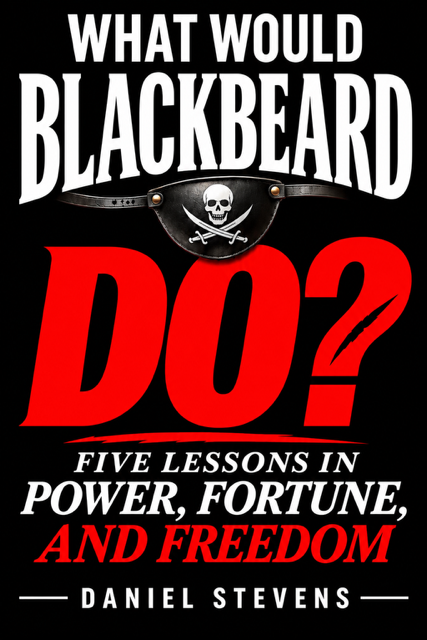
That’s the philosophy behind my forthcoming book, What Would Blackbeard Do? A Pirate’s Guide to Success in Business, Life & Romance.
After all, the most important question isn’t where the treasure is buried.
It’s whether you’re brave enough to take the helm and seize the treasure.
About the Author
Daniel Stevens is an entrepreneur, marketing executive, and founder of Pirata Group Marketing, a Florida-based digital marketing and creative production company.
He holds a Bachelor of Science in Business Administration with a concentration in Marketing from the University of Central Florida, an Executive Certificate in Negotiation from the University of Notre Dame, and a Master of Arts in Digital Content from Liberty University.
His forthcoming book, What Would Blackbeard Do? A Pirate’s Guide to Success in Business, Life & Romance, explores freedom, entrepreneurship, leadership, and relationships through an unconventional historical lens. Learn more at www.piratagroup.com and www.piratagroupmarketing.com.