Commissionability: The Decisions You Make in Engineering Determine the Success of Commissioning
By Daniel Roa Vidal
Many of the problems we encounter during commissioning do not actually begin during commissioning.
They begin months—or sometimes years—earlier.
A missing isolation valve. A system that cannot be energized independently. A drain located where it cannot be safely accessed. A control philosophy that cannot be tested progressively. Equipment installed correctly but without adequate access for inspection or maintenance. A turnover sequence designed around construction progress rather than the way the plant must ultimately start.
By the time these problems reach the commissioning team, the drawings have been issued, equipment has been purchased, piping has been installed, cables have been terminated, schedules are under pressure, and changing anything becomes expensive.
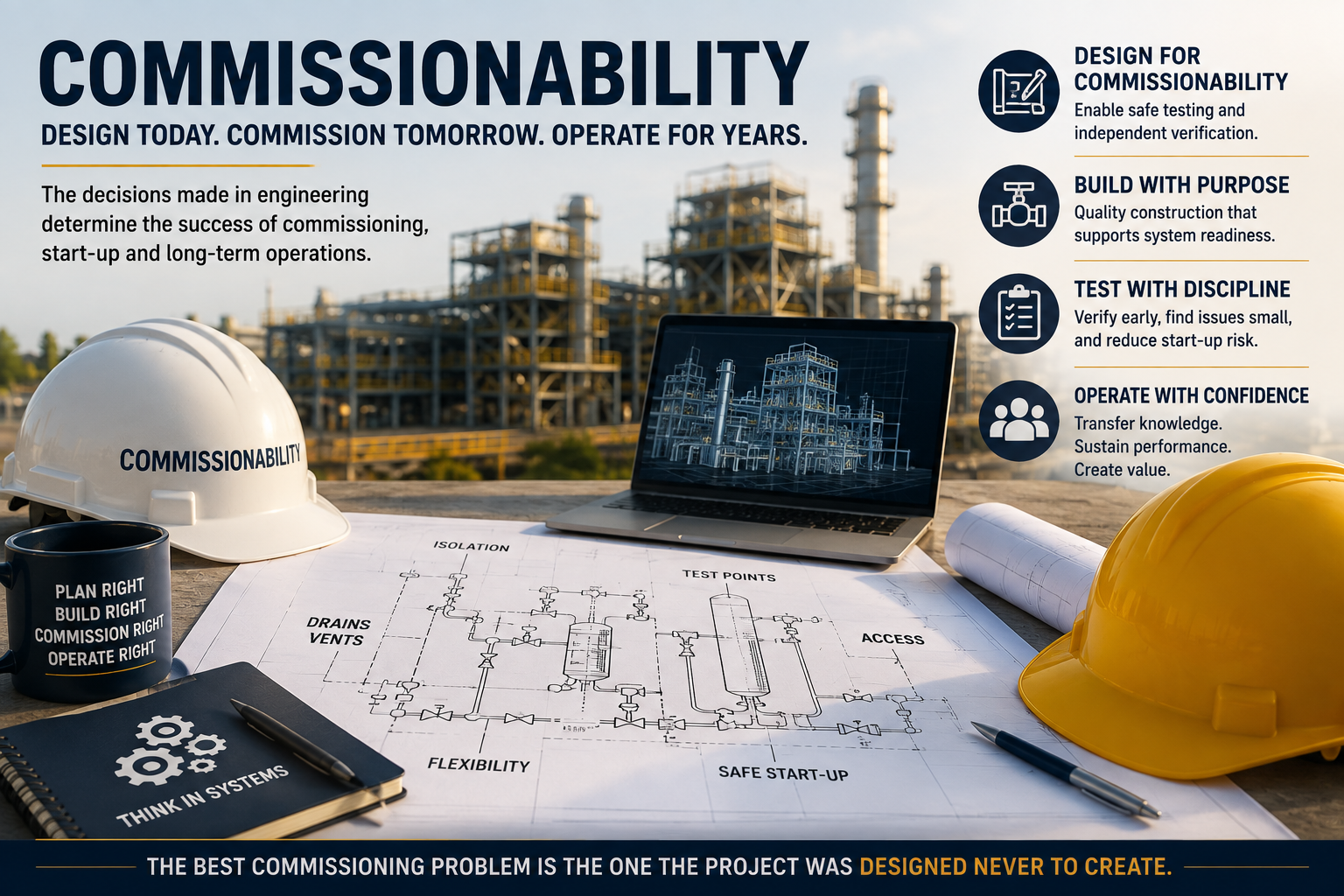
This is why I believe major projects need to think much earlier about Commissionability.
For me, Commissionability is a simple principle:
A facility should not only be designed to be built. It should be designed to be safely tested, commissioned, started, operated, and maintained.
That change in perspective can have an enormous impact on project execution.
Commissioning Begins With Engineering Decisions
Traditional project execution often treats commissioning as a downstream activity.
Engineering designs. Procurement buys. Construction builds. Commissioning tests. Operations receives the facility.
On paper, the sequence appears logical.
In reality, these phases are deeply interconnected.
A decision made during engineering can determine whether a commissioning activity months later takes four hours, four days, or requires a redesign.
Consider something as basic as system isolation.
From a process engineering perspective, a valve may satisfy the design requirements for normal operation. But during commissioning, we may need to isolate part of that system so another section can be flushed, pressure-tested, energized, functionally tested, or operated independently.
If the design does not provide that flexibility, the commissioning sequence becomes dependent on construction completion elsewhere in the plant.
One engineering decision has now affected the schedule.
This is Commissionability.
It means looking at the design not only through the question:
“Will this facility operate?”
but also:
“How will we safely prove that it can operate?”
The Cost of Solving Problems Changes With Time
There is a simple reality in major projects:
The earlier a problem is identified, the easier and less expensive it is to solve.
Moving a valve on a P&ID during design may require a discussion and a drawing revision.
Adding that same valve after piping has been fabricated and installed may require engineering changes, procurement, demolition, welding, inspection, testing, schedule adjustments, and additional costs.
The technical problem is identical.
The project impact is completely different.
The same principle applies to electrical systems, instrumentation, automation, mechanical equipment, access, maintainability, temporary facilities, and system boundaries.
This is why experienced commissioning and Operations personnel should participate in design reviews.
Not to redesign the plant.
Not to interfere with Engineering.
But to bring another question to the table:
How are we going to commission this?
That question can reveal issues that are almost invisible when the project is viewed only from a design or construction perspective.
Design the Plant Around Systems, Not Only Areas
Construction naturally thinks geographically: foundations, buildings, structures, areas, floors, and construction packages.
Commissioning thinks differently.
We think in systems and subsystems.
Electrical distribution. Lubrication systems. Cooling water. Compressed air. Process water. Control systems. Grinding circuits. Flotation circuits. Utilities.
These systems frequently cross construction boundaries.
That difference matters.
A building may be 95 percent complete while a critical system running through it is only 70 percent ready. Conversely, a complete commissioning system may be available even though surrounding construction activities continue.
Good systemization identifies these relationships early.
It allows Engineering, Construction, and Commissioning to align turnover priorities around the sequence required to start the facility.
When systemization begins too late, the project often discovers that construction completion and commissioning priorities do not match. Then the commissioning team starts chasing individual components across the project.
That is inefficient.
Commissionability asks the project to think about those boundaries before construction reaches the field.
Isolation Is a Commissioning Tool
One of the most valuable characteristics of a commissionable facility is the ability to separate systems safely.
Isolation allows teams to test progressively. It permits one system to advance while another remains under construction. It enables flushing, cleaning, energization, functional testing, and controlled introduction of utilities without unnecessarily exposing incomplete systems.
Poor isolation creates dependencies.
Good isolation creates flexibility.
During design reviews, therefore, we should carefully consider electrical and process isolation points, blinds and physical separation requirements, drains and vents, temporary flushing connections, test points, bypass requirements, safe access, stored-energy control, and boundaries between systems under different ownership.
These details may appear minor during engineering.
During commissioning, they can determine whether an activity is simple, difficult, or unsafe.
Control Systems Must Also Be Commissionable
Commissionability is not limited to mechanical design.
Modern industrial facilities depend heavily on automation.
Thousands of instruments, signals, interlocks, permissives, sequences, alarms, trips, drives, controllers, and communication networks must eventually work together.
Waiting until the entire plant is complete before proving that integration is a mistake.
A commissionable automation architecture should allow progressive testing.
Individual instruments should be verified. Loops should be tested. Motor control should be validated. Interlocks and permissives should be proven. Sequences should be simulated where appropriate. Interfaces between packages should be tested before production depends on them.
The objective is simple:
Find problems when they are still small.
The first time we discover a critical control logic problem should not be when the plant is full of material and everyone is waiting for production.
Temporary Requirements Are Still Project Requirements
Another recurring lesson from commissioning is that temporary systems are often treated as secondary.
They should not be.
Temporary power, water, hoses, piping, flushing arrangements, test equipment, communications, lighting, scaffolding, access platforms, and temporary isolation can all be essential to the commissioning sequence.
If these requirements are identified late, they become emergency activities.
If they are identified during planning and engineering, they become part of the execution strategy.
Commissionability therefore requires asking not only what the permanent facility needs, but also:
What will we need to safely get from construction to operation?
That transition has infrastructure requirements of its own.
Operations Should Arrive Before Start-Up
Commissionability also has a human dimension.
The people who will operate and maintain the facility should have an opportunity to influence the project before handover.
Operators see things differently from designers.
Maintenance personnel see things differently from constructors.
Commissioning sees things differently from both.
An operator may notice that a valve is technically accessible but practically difficult to operate. A maintainer may recognize that removing a component will require dismantling equipment around it. A commissioning specialist may identify that a system cannot be tested independently.
None of these observations necessarily mean the engineering is wrong.
They mean the design is being examined from the perspective of its entire lifecycle.
That is exactly what good project integration should achieve.
Commissionability Is Not About Making Commissioning Easier
This distinction is important.
Commissionability is not about making life easier for the commissioning team.
The commissioning team eventually leaves.
Operations remains.
A design that is easier to isolate is generally safer to maintain. A system that can be tested independently is usually easier to troubleshoot. Clear system boundaries improve ownership. Better access improves maintenance. Well-designed test points support future diagnostics. Early Operations involvement improves familiarity with the plant. Better documentation helps everyone.
The real beneficiary of Commissionability is therefore the asset itself and the organization that will operate it for decades.
Commissionability Improves Schedule Without Compromising Safety
Projects are always under schedule pressure.
That will not change.
The question is how we respond to it.
One approach is to reach the end of construction and attempt to accelerate commissioning by compressing activities.
A better approach is to design the project so commissioning can begin progressively and safely.
That means creating opportunities for early energization, early utilities, early control-system testing, progressive subsystem turnover, independent equipment testing, water runs, functional testing, Operations training, documentation turnover, and punch-list reduction before start-up.
When these activities are planned early, commissioning does not become an obstacle between Construction and Operations.
It becomes part of the project execution strategy.
That is how Commissionability can improve schedule performance without asking teams to take unnecessary shortcuts.
A Different Question During Design Reviews
After decades of working in commissioning and start-up, I have learned that some of the most valuable questions on a project are often the simplest.
During engineering reviews, we naturally ask:
Does it meet the specification?
Does it meet the code?
Will it achieve the required capacity?
Is it safe?
Is it maintainable?
I believe we should add another:
Is it commissionable?
Can we isolate it?
Can we energize it?
Can we test it?
Can we prove the logic?
Can we access it?
Can we safely introduce utilities?
Can we progressively transfer ownership?
Can Operations understand and maintain it?
And ultimately:
Can we demonstrate, safely and systematically, that this facility is ready to become an operating asset?
If we wait until commissioning to answer those questions, we have waited too long.
Design for the Entire Journey
Every major project eventually has to make the same transition.
From drawings to equipment.
From equipment to systems.
From systems to an integrated facility.
From a facility to an operating asset.
Commissionability means designing with that entire journey in mind.
It connects Engineering with Construction, Construction with Commissioning, Commissioning with Start-Up, and Start-Up with Operations.
The objective is not to add another layer of complexity to projects.
It is exactly the opposite.
It is to remove complexity before it reaches the field.
Design it right.
Build it right.
Commission it right.
Operate it right.
Because the best commissioning problem is not the one we solve quickly during start-up.
It is the one the project was designed never to create.
About the Author
Daniel Roa Vidal is a global commissioning, start-up, and major projects executive with more than three decades of international experience across mining, energy, industrial, water, and infrastructure projects. As Director of Major Projects and Commissioning Manager at Reliable Controls Corporation, he advocates for Commissionability, Operational Readiness, technical discipline, and knowledge transfer as fundamental elements of successful project delivery.