These stages are connected, but they are not interchangeable.
Confusing them creates risk.
A system should not advance simply because the schedule says it should. It should advance because the technical conditions required for the next stage have been demonstrated.
This becomes especially important as projects approach start-up.
The closer a project gets to production, the greater the pressure becomes.
Schedules become tighter. Milestones become more visible. Management wants progress. Operations wants the plant. Contractors want completion.
That pressure is understandable.
But schedule pressure must never replace technical readiness.
Going Faster Does Not Mean Skipping Steps
There is nothing wrong with aggressive schedules.
Commissioning professionals work under pressure constantly. Our responsibility is to find ways to execute faster without removing the controls that make execution safe.
That requires planning.
It requires systemization.
It requires clearly defined priorities and boundaries.
It requires good turnover management.
It requires testing sequences that allow teams to work progressively rather than waiting for the entire facility.
And above all, it requires a clear chain of command.
During energization, functional testing, and start-up, ambiguity regarding authority can become dangerous.
People need to know:
- Who owns the system?
- Who authorizes the test?
- Who controls the equipment?
- Who has the authority to stop the activity?
- What conditions must be satisfied before proceeding?
When these responsibilities are unclear, pressure can turn ordinary execution problems into safety incidents.
Leadership during commissioning is therefore not simply about pushing the organization toward start-up.
Sometimes leadership means saying go.
Sometimes it means saying not yet.
The responsibility is knowing the difference.
The Human Side of Commissioning
Technology has transformed our industry.
Modern facilities contain sophisticated automation, advanced instrumentation, digital control systems, variable-speed drives, condition monitoring, data analytics, and increasingly intelligent systems.
Yet successful commissioning remains deeply dependent on people.
Engineering knows why the facility was designed a certain way.
Construction knows how it was actually built.
Vendors understand their equipment.
Commissioning understands how systems must be integrated and proven.
Operations understands how the facility ultimately needs to run.
Maintenance understands what will be required to keep it running.
The best results occur when those groups stop operating as separate organizations and begin working as one integrated team.
Commissioning sits at the intersection of all of them.
That is why communication, leadership, ownership, technical discipline, and mutual respect are just as important as procedures and test sheets.
Operational Readiness Is the Real Finish Line
For me, the ultimate objective of commissioning has never been simply to start equipment.
Starting a motor is easy.
Starting a plant is considerably more complicated.
Handing over an asset that Operations can safely and confidently own is something else entirely.
Operational readiness means that the organization receiving the facility has the people, procedures, documentation, training, spare parts, maintenance strategies, systems, and knowledge required to operate it successfully.
The physical plant may be ready while the organization is not.
That is why Operations should not meet the facility for the first time at handover.
Their participation should begin much earlier.
A successful project does not simply transfer equipment.
It transfers ownership, knowledge, and confidence.
Experience Has Value Only When It Is Transferred
After more than three decades in this profession, I remain convinced that commissioning is one of the best classrooms in the industrial world.
Every project teaches you something.
Every start-up challenges assumptions.
Every failure forces you to understand something more deeply.
Every successful handover reminds you that hundreds or thousands of people contributed to making that moment possible.
But experience has limited value if we keep it to ourselves.
One of our responsibilities as senior professionals is to transfer what we have learned to the next generation of engineers, supervisors, technicians, operators, and commissioning leaders.
Not simply the procedures that worked, but also the mistakes.
Not simply what we did, but why we did it.
The industry becomes stronger when lessons learned on one project become better practices on the next.
Where the Project Becomes Real
I have spent much of my professional life watching facilities make that extraordinary transition from construction to operation.
There is always a moment when drawings, specifications, cables, pipes, equipment, control logic, and thousands of hours of human effort stop being individual pieces of a project and begin functioning together as a plant.
That moment is what commissioning prepares for.
And that is why I believe commissioning deserves to be recognized not as the end of construction, but as a strategic discipline that should influence the entire project lifecycle.
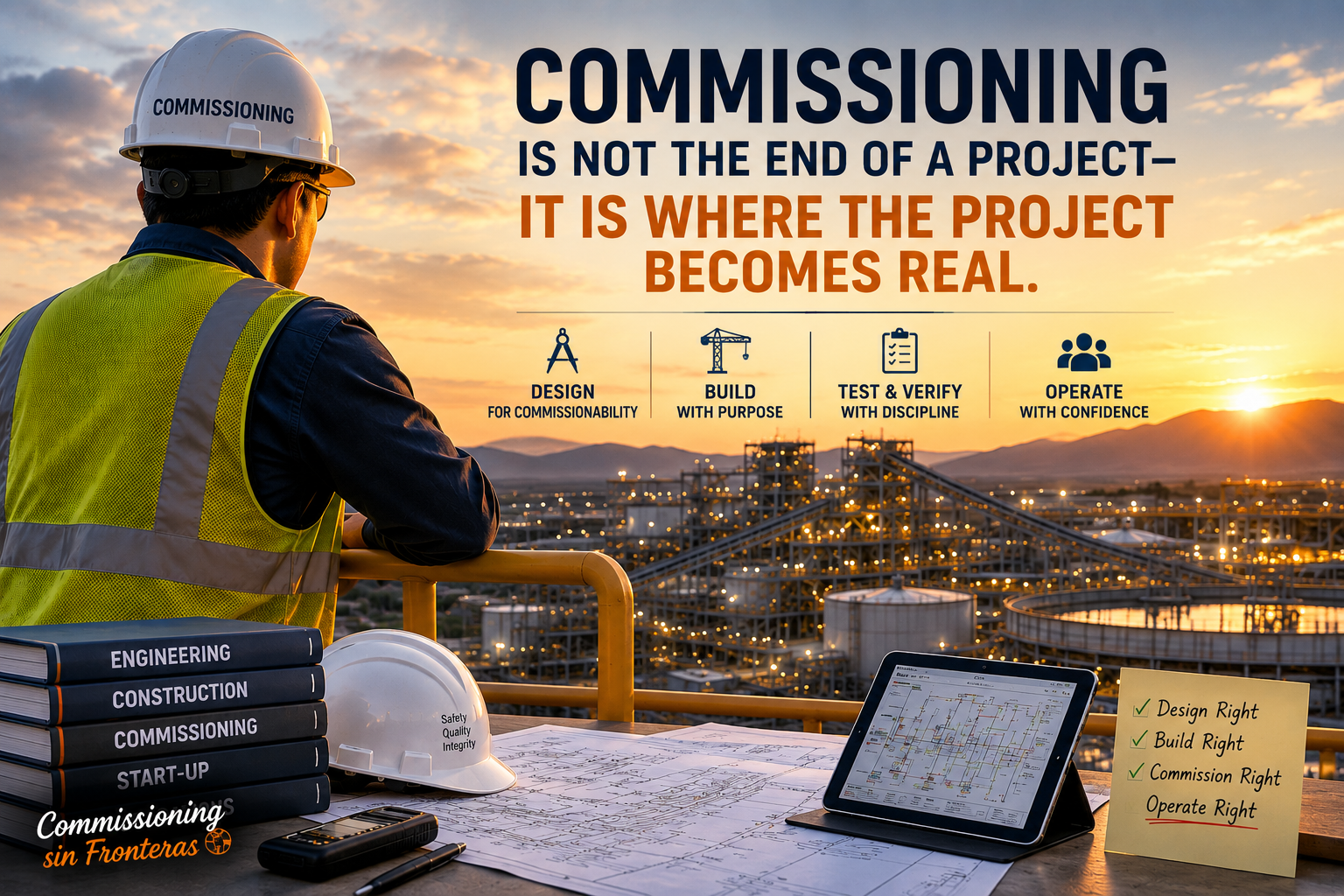
Design for Commissionability.
Build with commissioning in mind.
Commission with Operations involved.
Start only when technically ready.
Transfer knowledge along with the asset.
Because ultimately, a successful project is not one that is simply completed.
It is one that is ready to operate—safely, reliably, and with confidence from day one.
About the Author
Daniel Roa Vidal is an international commissioning, start-up, and major projects executive with more than three decades of experience across mining, energy, industrial, water, and infrastructure projects worldwide. He serves as Director of Major Projects and Commissioning Manager at Reliable Controls Corporation and advocates for Commissionability, Operational Readiness, technical discipline, and knowledge transfer as fundamental elements of successful project delivery.