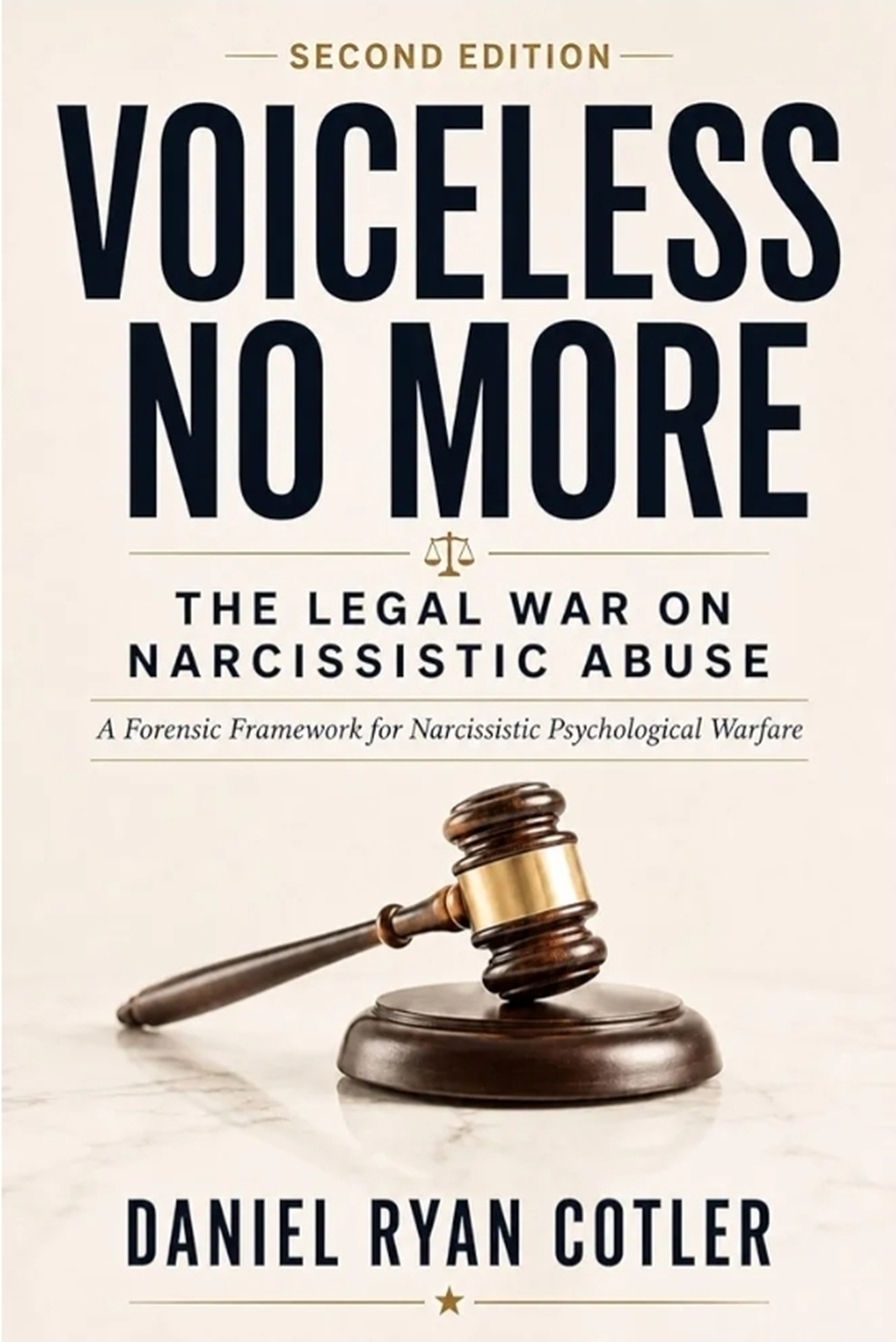
Daniel Ryan Cotler is a survivor, international bestselling author, advocate, and founder and executive director of the Heal Loudly Movement, a survivor-centered advocacy platform dedicated to changing the way severe psychological abuse, coercive control, post-separation abuse, and survivor suicide are understood. He is the creator of the Narcissistic Psychological Warfare framework, author of Voiceless No More: The Legal War on Narcissistic Abuse, and founder of the Voiceless Justice Act, an advocacy initiative calling for stronger legal recognition, protection, and accountability for survivors of psychological abuse.
At the center of Cotler’s work is his belief that severe psychological abuse must be understood as far more than a toxic relationship or emotional conflict. Through his Narcissistic Psychological Warfare framework, Cotler identifies a progressive system of manipulation, coercive control, identity erosion, dependency, psychological punishment, captivity, post-separation abuse, and destruction. His framework gives survivors language for patterns of abuse that are often invisible to outsiders, difficult to prove inside institutions, and devastating to the survivor’s mind, body, nervous system, reputation, relationships, and will to live.
A major part of Cotler’s framework is his work around Psychological Homicide, which examines the relationship between narcissistic psychological abuse, institutional failure, coercive control, and suicide. Cotler argues that many survivor suicides are not isolated mental health tragedies. They are often the foreseeable outcome of prolonged psychological warfare, social isolation, reputational destruction, legal abuse, emotional captivity, and repeated failures by institutions to intervene or protect. His work challenges communities, courts, law enforcement, medical systems, and the public to recognize that when a person is psychologically terrorized, disbelieved, erased, and left without protection, the resulting death cannot be understood apart from the abuse that led to it.
Cotler also developed the concept of Neurological Battery, which frames sustained psychological abuse as an injury to the brain and nervous system, not merely an emotional wound. His advocacy highlights how prolonged coercive control, gaslighting, fear, sleep deprivation, isolation, humiliation, intermittent reinforcement, and chronic threat can affect memory, emotional regulation, executive function, identity, decision-making, and physical health. Through this framework, Cotler argues that invisible injuries still require recognition, documentation, accountability, and protection.
His eight-stage Narcissistic Psychological Warfare framework begins with Indoctrination: Grooming the Victim for Capture, where the abuser uses mirroring, love bombing, false intimacy, future faking, and emotional targeting to create a manufactured bond. Cotler connects this stage to what he calls the Constructive Fraud of Intimacy, where the victim is drawn into attachment through a false presentation of safety, compatibility, loyalty, love, or shared purpose. What appears from the outside as closeness or romance may actually be the beginning of psychological conditioning.
The second stage, Psychological Breakdown: Stripping Identity, involves the gradual erosion of the survivor’s self-trust, memory, confidence, emotional regulation, and sense of reality. Through gaslighting, contradiction, blame shifting, projection, circular arguments, sleep deprivation, isolation, and emotional destabilization, the abuser begins to make the survivor question their own mind. Cotler’s work emphasizes that this is not ordinary conflict. It is a sustained attack on perception, identity, and nervous system stability.
The third stage, Psychological Enslavement: Creating Dependency, explains how survivors become trapped not because they are weak, but because the abuse changes the conditions under which they are forced to think, decide, and survive. Cotler identifies this as part of Trauma Encoded Dependency, where intermittent reinforcement, fear, attachment, hope, confusion, and threat become emotionally and neurologically fused. The survivor may know something is wrong while also feeling unable to leave, unable to explain it, and unable to trust their own instincts.
The fourth stage, Mental Reprogramming: Controlling Perception, focuses on how abusers reshape the survivor’s understanding of reality. Through repeated distortion, denial, selective affection, punishment, and reality inversion, the survivor may begin to see themselves through the abuser’s accusations. Cotler’s framework gives language to the internal collapse that can happen when someone is forced to defend reality every day while being told they are unstable, abusive, dramatic, paranoid, or dangerous.
The fifth stage, Psychological Punishment: Crushing Resistance, identifies the retaliation that occurs when the survivor begins to question, resist, expose, or leave. This may include silent treatment, humiliation, threats, smear campaigns, legal intimidation, financial control, abandonment, public distortion, or emotional cruelty. Cotler also challenges the term “reactive abuse,” replacing it with Coerced Defensive Aggression, a more accurate description of what happens when a person is provoked, cornered, destabilized, and then blamed for their survival response.
The sixth stage, Psychological Submission: Enforcing Helplessness, describes the point where the survivor may stop fighting back because every attempt to defend themselves has been punished, twisted, or used against them. This stage can look like compliance, numbness, silence, confusion, collapse, or emotional shutdown. Cotler’s work highlights that many survivors are not silent because nothing happened. They are silent because the abuse trained them that speaking would cost them more.
The seventh stage, Psychological Captivity: Ensuring Long-Term Control, addresses the cycles of discard, hoovering, surveillance, litigation abuse, social manipulation, reputational sabotage, and post-separation control that can continue long after the relationship ends. Cotler’s framework is especially focused on post-separation abuse because many systems treat separation as the end of harm, when for survivors it can mark the beginning of the most dangerous and legally complex phase. Abusers may continue the abuse through courts, police reports, family systems, social media, mutual contacts, employment sabotage, and public character assassination.
The final stage, Destruction and Erasure: The Final Betrayal, names the devastating end goal of this pattern: the destruction of the survivor’s credibility, identity, stability, relationships, finances, health, reputation, and sometimes their will to live. This stage connects directly to Cotler’s work on Psychological Homicide because it identifies the point where abuse is no longer only about control. It becomes an organized destruction of the person’s ability to exist safely, be believed, access help, and imagine a future.
Through the Heal Loudly Movement, Cotler has built a platform rooted in survivor education, peer-to-peer support, public awareness, suicide prevention, and practical tools. The movement provides language, resources, documentation support, educational content, and survivor-centered advocacy for people who often feel abandoned by the very systems they turned to for help. Heal Loudly is built around the reality that survivors need words, witnesses, structure, community, and practical support while trying to rebuild their lives.
His book, Voiceless No More: The Legal War on Narcissistic Abuse, became a central part of that mission. Written from the perspective of a survivor fighting to name what happened, the book examines the emotional, psychological, legal, and institutional dimensions of narcissistic abuse and coercive control. It reflects Cotler’s larger belief that survivors are often forced into a second battle after the abuse itself: the battle to be believed, understood, and protected.
Cotler is also the creator of the Voiceless Justice Act, an advocacy initiative calling for stronger recognition of psychological abuse, coercive control, post-separation abuse, litigation abuse, neurological harm, and the connection between severe psychological abuse and survivor suicide. Through this initiative, Cotler is working to bring survivor experiences into conversations about law, public policy, institutional accountability, and meaningful protection. His advocacy calls attention to the gap between what survivors endure and what existing systems are often prepared to recognize.
His public advocacy has extended into suicide prevention and community education, where he speaks about the connection between psychological abuse, institutional failure, isolation, and survivor suicide. Cotler emphasizes that many survivors do not die because they wanted to disappear. They die because they were systematically erased, disbelieved, exhausted, and left without protection. His message, “We heal loudly because we almost died in silence,” has become a central expression of the Heal Loudly Movement and the philosophy behind his work.
Cotler’s impact comes not only from what he has survived, but from what he has built from it. He has turned personal devastation into a public framework, a movement, a book, an advocacy initiative, survivor resources, peer-support efforts, and a growing body of educational work designed to help others name the abuse they endured. His work stands at the intersection of lived experience, survivor advocacy, legal reform, trauma education, suicide prevention, and public accountability.
At its core, Daniel Ryan Cotler’s mission is to make invisible abuse visible. He is working to ensure that survivors of Narcissistic Psychological Warfare are no longer dismissed as unstable, overly emotional, vindictive, or impossible to understand. His framework gives survivors language. His movement gives them community. His advocacy demands that institutions stop looking away. His writing gives voice to people who have been forced to fight not only the abuse, but the disbelief that follows it.
What began as one survivor’s decision to break the silence has become a larger mission to educate communities, challenge institutions, amplify unheard voices, and fight for a future where psychological abuse is recognized for what it is: a serious, patterned, and destructive form of abuse that demands language, protection, accountability, and justice.
Sign the Voiceless Justice Act petition:
Change.org/voicelessjusticeact