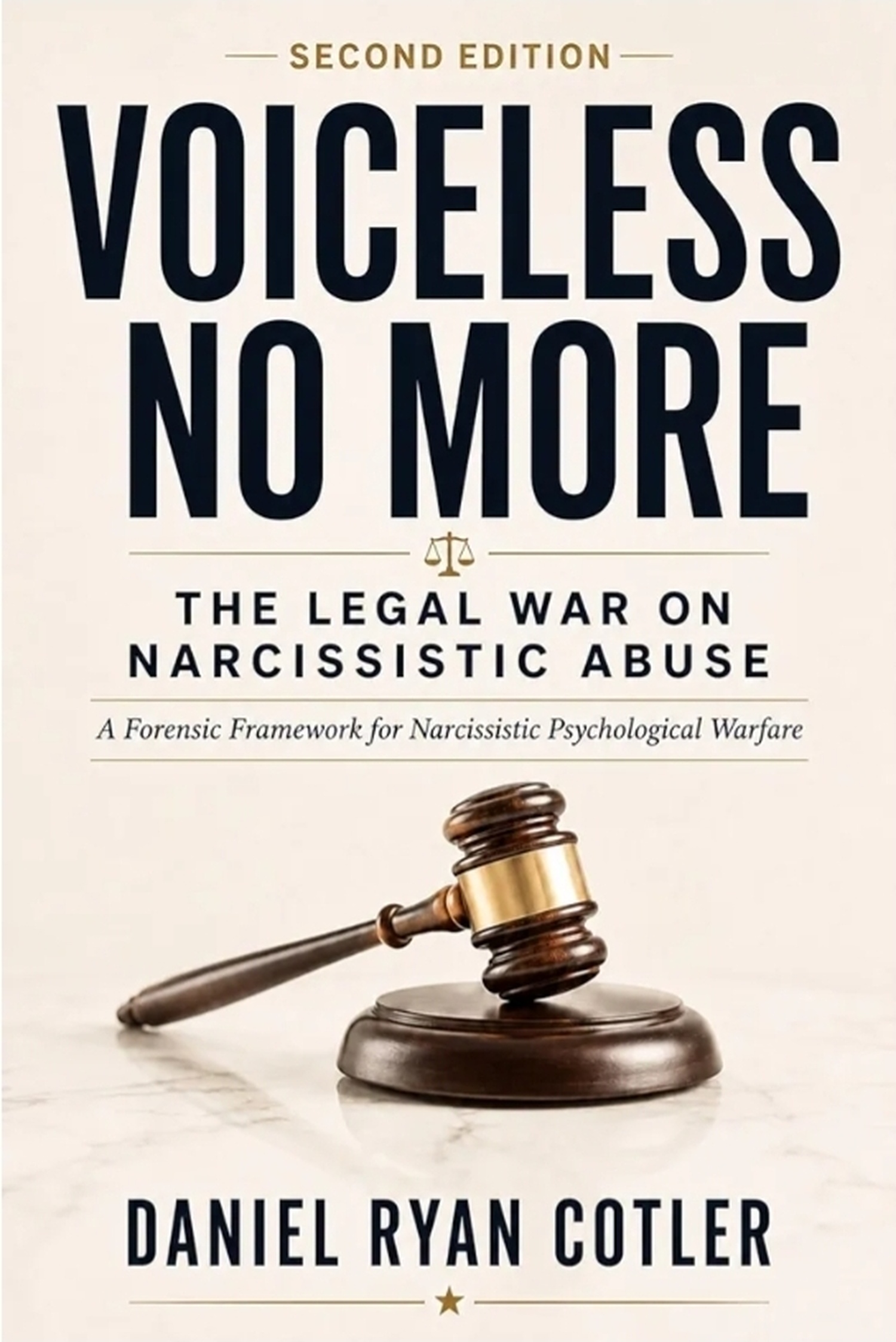
VOICELESS NO MORE: THE LEGAL WAR ON NARCISSISTIC ABUSE
By Daniel Ryan Cotler
I did not write Voiceless No More: The Legal War on Narcissistic Abuse because I wanted to tell the story of a bad relationship. I wrote it because what I survived forced me to confront a much larger problem: we still do not have adequate language for what happens when psychological abuse becomes systematic, calculated, prolonged, and destructive.
For years, I watched experiences that had devastated every part of my life get reduced to words that never seemed large enough: toxic, manipulative, dysfunctional, narcissistic abuse, and high conflict. Those words may describe pieces of the experience, but they did not describe the machinery behind it.
What I experienced was not simply a collection of cruel behaviors. It was a process. There was a progression to it. The person I was when I entered that relationship was gradually stripped away through manipulation, dependency, confusion, punishment, isolation, coercion, and control.
When I finally began putting the pieces together, I realized something that would eventually become central to my work: I had not simply survived abuse. I had survived what I came to define as Narcissistic Psychological Warfare.
That realization became the foundation for Voiceless No More and ultimately for the Eight Stages of Narcissistic Psychological Warfare.
The Legal War
The title The Legal War on Narcissistic Abuse was intentional.
Survivors frequently discover that escaping the relationship does not necessarily end the abuse. Separation can simply change the battlefield. The relationship may end, but the psychological warfare can continue through harassment, false accusations, smear campaigns, financial pressure, litigation abuse, institutional manipulation, social isolation, reputational destruction, and attempts to control how other people perceive the survivor.
Then survivors enter systems that demand evidence from people whose lives have often been deliberately thrown into chaos. We are expected to remember dates while living with trauma. We are expected to explain years of psychological manipulation in a few minutes. We are expected to produce a perfect timeline from an experience designed to keep us confused.
Perhaps most damaging, individual incidents are often examined separately. One message may appear insignificant. One lie may appear insignificant. One threat may appear insignificant. One false accusation may appear insignificant. One episode of gaslighting may appear insignificant.
But psychological warfare cannot be understood by examining one incident at a time. The pattern is the evidence.
That is one of the reasons I wrote Voiceless No More. I wanted survivors to have language for the pattern they had lived through and a framework that could help them understand how seemingly disconnected behaviors can operate together as a system of psychological control.
The Eight Stages of Narcissistic Psychological Warfare
As I studied my own experience and the patterns described by other survivors, I began identifying a progression. That progression became my Eight Stages of Narcissistic Psychological Warfare.
The framework does not suggest that every abusive relationship unfolds identically or that human behavior can always be placed neatly into eight boxes. It provides a way of examining how severe psychological abuse can develop and escalate over time.
Stage One: Indoctrination — Grooming the Victim for Capture
People often ask why someone would stay with an abusive person. That question frequently begins at the wrong point in the story.
The survivor did not knowingly enter the relationship presented with the person they would eventually encounter. They entered through trust.
This is where I identify Constructive Fraud of Intimacy. The survivor may be presented with extraordinary compatibility, affection, vulnerability, attention, mirroring, promises, and a vision of a shared future. The relationship can feel unusually intense because emotional intimacy is being accelerated.
The very things later used against the survivor may first be learned during this period of trust: their fears, vulnerabilities, dreams, history, insecurities, and need for connection.
This is also where what I call Trauma Encoded Dependency can begin developing. Dependency does not suddenly appear after the abuse becomes obvious. The emotional architecture can begin forming while the survivor still believes they are building a safe relationship.
Stage Two: Psychological Breakdown — Stripping Identity
Once attachment has been established, the environment begins changing. Criticism appears. Reality becomes unstable. Contradictions multiply. Gaslighting, blame shifting, projection, humiliation, circular arguments, word salad, rapid-fire questioning, stonewalling, and other destabilizing behaviors can begin wearing away at the survivor's confidence.
Eventually, the survivor may stop asking, “Why is this person treating me this way?” Instead, they begin asking, “What am I doing wrong?”
That shift matters. When someone can make you distrust your own perception, they no longer have to control every decision you make. You begin policing yourself.
Stage Three: Psychological Enslavement — Creating Dependency
By this stage, the survivor may be investing enormous amounts of energy trying to restore the person or relationship they experienced in the beginning.
Affection and punishment can alternate. Hope returns just often enough to keep the survivor engaged. This intermittent reinforcement can intensify the dependency that began during the earlier formation of the relationship.
The survivor may know something is terribly wrong while simultaneously feeling unable to leave it. That contradiction is one of the hardest things for outsiders to understand.
Stage Four: Mental Reprogramming — Controlling Perception
Prolonged manipulation can begin changing the survivor's relationship with reality itself. They may repeatedly defend themselves against accusations that make no sense. They may spend hours explaining what they meant, proving what happened, producing screenshots, reconstructing conversations, or attempting to resolve contradictions that never seem to resolve.
Eventually, enormous amounts of mental energy are consumed simply trying to establish reality.
I know what it is like to reach a point where you no longer trust your own memory, instincts, or interpretation of events. That is not ordinary relationship conflict.
When a person has been conditioned to distrust their own perception, control can become internalized.
Stage Five: Psychological Punishment — Crushing Resistance
When the survivor resists, punishment may escalate. This can include silence, abandonment, threats, humiliation, rage, withdrawal, triangulation, false accusations, sleep disruption, financial pressure, public embarrassment, and threats involving relationships, housing, employment, children, reputation, or other vulnerabilities.
The survivor begins learning that resistance carries consequences. Eventually, keeping the peace can become more important than expressing the truth.
Stage Six: Psychological Submission — Enforcing Helplessness
After enough cycles of resistance followed by punishment, exhaustion can replace resistance. The survivor may become increasingly focused on preventing the next explosion, accusation, abandonment, or psychological attack.
From the outside, that can look like passivity. From inside the experience, it can feel like survival.
This is also why I reject the term reactive abuse for many survivor responses. When a person is subjected to sustained psychological pressure and eventually screams, argues, fights back, or emotionally erupts, labeling their response “abuse” can erase the coercive environment that preceded it.
I use the term Coerced Defensive Aggression because context matters. A reaction cannot be honestly understood if the conditions that produced it are deliberately removed from the story.
Stage Seven: Psychological Captivity — Ensuring Long-Term Control
Physical separation does not necessarily create psychological freedom. The survivor may remain trapped through fear, trauma, financial consequences, litigation, intermittent contact, threats, smear campaigns, social manipulation, or cycles of discard and hoovering.
This is where society's obsession with asking, “Why didn't you just leave?” becomes especially inadequate. Sometimes the survivor did leave. The abuse followed them.
Post-separation abuse can become its own system of control.
Stage Eight: Destruction and Erasure — The Final Betrayal
The final stage is what I describe as destruction and erasure. By this point, the objective may no longer appear to be preserving the relationship. It can become destroying the survivor's credibility, relationships, stability, reputation, identity, or ability to tell their own story.
The survivor can find themselves defending not merely what happened, but who they are.
That is why the word erasure matters to me. After prolonged psychological warfare, many survivors are not simply trying to recover from someone who hurt them. They are trying to recover themselves.
When Psychological Violence Becomes a Public Issue
Writing Voiceless No More changed the direction of my life because I could no longer see this only as something that happened to me.
Once you recognize the pattern, you begin seeing the gaps surrounding survivors. You see what happens when police do not understand coercive control. You see what happens when courts examine incidents without examining patterns. You see what happens when institutions mistake trauma responses for credibility problems. You see what happens when a survivor is forced to repeatedly explain years of psychological destruction to people looking for one obvious moment of violence.
You also begin asking harder questions about the physical and neurological consequences of prolonged trauma.
I use the term Neurological Battery to push that conversation forward. Severe and prolonged psychological trauma can affect memory, concentration, emotional regulation, threat perception, sleep, and executive functioning. The body and brain do not experience sustained terror as something imaginary simply because another person did not leave a visible bruise.
That distinction matters enormously. Psychological violence can leave consequences that nobody standing across from the survivor can see.
From a Book to a Movement
I never expected this work to stop with a book. Voiceless No More became part of something much larger.
It contributed to the creation of the Heal Loudly Movement, my advocacy work, survivor education, peer support, and ultimately the Voiceless Justice Act, an effort to push the conversation beyond awareness and toward institutional accountability and meaningful legal reform.
Because awareness without change is not enough.
Survivors do not simply need people to tell them, “I believe you.” They need systems capable of understanding what they are describing. They need courts capable of recognizing patterns. They need professionals educated about coercive control and post-separation abuse. They need practical resources for documenting what is happening. They need communities that understand why leaving does not automatically create safety.
And they need language powerful enough to describe what was done to them.
Why I Became Voiceless No More
There is a reason I chose that title.
Abuse attempts to take ownership of your voice. It teaches you to remain silent because speaking produces consequences. It teaches you to question yourself before questioning the person hurting you. It teaches you that nobody will believe you, that nobody will understand, and eventually that telling the truth is more dangerous than keeping it buried. For a long time, silence felt safer. It isn't anymore.
Today, I speak because I know there are survivors sitting somewhere right now trying to understand why they cannot think clearly, why they cannot simply “move on,” why they still feel trapped after leaving, or why nobody seems to understand what happened to them.
I want them to know that the individual incidents they keep replaying may be pieces of something much larger.
Look at the pattern. Look at the progression. Look at what happened to your identity, your perception, your independence, your nervous system, your relationships, and your ability to trust yourself.
That is the conversation Voiceless No More was written to begin.
The book carries my story, but the mission stopped being only about my story a long time ago. It became about giving survivors language. It became about demanding that institutions learn to recognize psychological warfare before another survivor is destroyed trying to prove it exists. It became about turning survival into advocacy and silence into evidence.
And it became the principle behind everything I do today:
We heal loudly because we almost died in silence.