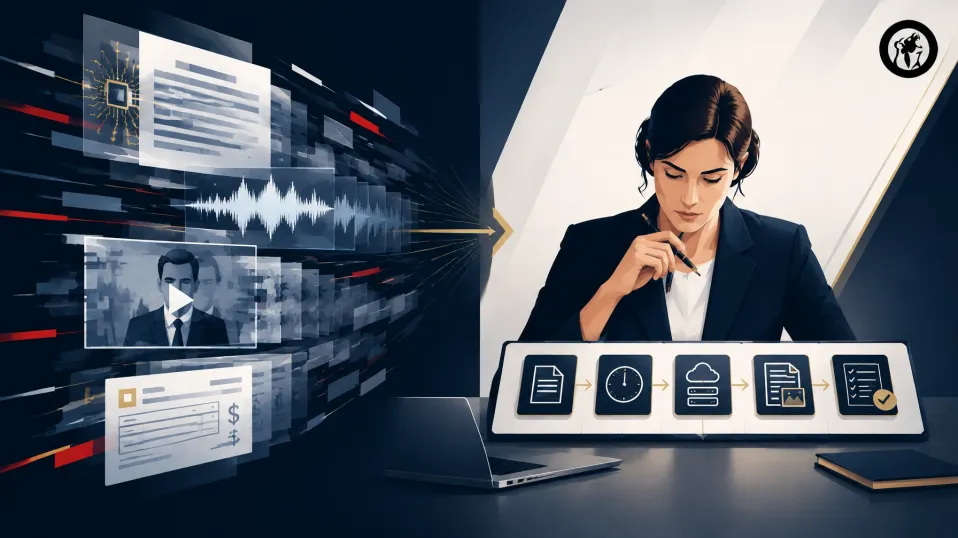
It now takes minutes, and almost no specialized skill, to produce a convincing fake document, cloned voice, fabricated invoice, or altered video.
It can take hours or days of disciplined work to prove that the material is false. Sometimes it cannot be proven false with certainty at all.
Fraud used to require capability. It now requires a subscription.
The cost of lying has collapsed. The cost of proving the truth has not.
That is not primarily a technology problem. It is a verification problem.
And verification is a leadership responsibility.
Production Is Fast. Proof Is Slow.
Generative tools can produce text, images, video, and audio that appear credible in ordinary use. A short voice sample can be enough to create a convincing imitation. A document can be formatted to resemble an invoice, a receipt, a bank statement, or a corporate record. An image can be altered without leaving obvious visual clues.
Detection tools help, but they are not a complete answer. Detection systems can produce false positives and false negatives. They can also be outpaced by the tools they are designed to identify.
A detection score is not the same thing as proof.
This is why organizations cannot build their entire response around asking whether a file “looks AI-generated.” The more durable question is different:
Where did this come from, and what independently supports it?
That is the central distinction between detection and verification.
Detection looks for signs of manipulation. Verification establishes provenance, context, ownership, handling, and corroboration. In an environment of synthetic media and AI misinformation, detection may be useful. Verification is what makes a decision defensible.
I have seen this distinction repeatedly in investigative work. A polished file can survive a casual review. It rarely survives sustained questions about its origin, who held it, how it was transmitted, whether the original exists, and whether another source confirms what it appears to show.
The Discipline Investigators Already Had
Professional investigators have long worked with a distinction that many organizations leave unstated.
Every material assertion should be classified as one of four things:
- Confirmed fact, independently corroborated, with the source identified.
- Unverified lead: plausible information that has not yet been independently confirmed.
- Inference or assessment: the investigator’s reasoned interpretation of facts and circumstances.
- Assertion by an interested party: something said by a person with a stake in the outcome.
The fourth category is important because a statement can be sincere and still not be evidence of itself.
This classification is not academic. It prevents an organization from quietly converting a claim into a fact as it moves through emails, meetings, reports, and executive summaries.
The distinction must be visible in the written product, not merely held in someone’s head.
A report should tell the reader what is known, what remains open, what is inferred, and who is making the assertion. That simple structure defeats a surprising amount of fabricated material because it forces the organization to examine the claim’s path rather than its appearance.
A document is not reliable because it looks official. A recording is not authentic because it feels persuasive. A repeated statement is not corroboration if every repetition traces back to the same original source.

Ask: “How Do You Know?”
This may be the highest-value question a leader can introduce into an organization.
Not as an accusation. As a normal operating habit.
Executives are routinely given conclusions:
- The vendor is legitimate.
- The numbers are fine.
- The candidate’s credentials are accurate.
- The insurance claim checks out.
- The partner is trustworthy.
- The complaint is unfounded.
- The acquisition target has represented its business accurately.
The weak response is another conclusion.
“The vendor has a good reputation.”
“The numbers came from finance.”
“Everyone says the candidate worked there.”
The stronger response identifies a source, a method, and a point of corroboration.
For vendor onboarding, ask which records were reviewed and whether the company’s ownership, address, licensing, and operating history were independently confirmed.
For executive hiring, distinguish between a résumé assertion, a reference statement, an employment record, and a credential verified directly through the issuing institution.
For an internal investigation, separate what an employee reported from what documents, access logs, interviews, or physical observations establish.
For insurance claims, ask whether the claimed loss is supported by contemporaneous records and independent evidence, rather than relying only on photographs or a narrative.
For M&A representations, identify which statements were tested against source records, not merely accepted because they appeared in a data room.
For board reporting, require a clear path from the reported number to the underlying system, record, or responsible person.
“How do you know?” changes the culture from confidence by repetition to confidence by provenance.
Provenance Is an Operating Asset
Chain of custody is often discussed as an evidentiary or legal concept. Its underlying discipline is useful far beyond a courtroom.
Preserve the original and work from copies.
Record who held the item and when.
Use a consistent time source and state the time zone.
Maintain an access log.
Document the method used to collect or process the material.
Identify the tool used.
Record any enhancement, conversion, compression, or alteration.
Note limitations instead of rounding them away.
These practices answer a basic question: can the organization explain the history of the information on which it acted?
The same standard should apply to a spreadsheet, an executive report, a customer complaint, a vendor file, and a digital recording. If a number changed, the organization should know when it changed, who changed it, and why. If a conclusion entered a report, the organization should know who first asserted it and what supported it.
The telling failure is not always that the number is wrong. It is that nobody can say where it came from.
In an environment of cheap fabrication, an organization that can demonstrate provenance has a real defensive and competitive advantage. It can respond to a regulator, customer, board member, journalist, or counterparty with more than confidence. It can show its work.
That is not a compliance chore. It is operational resilience.
Sometimes You Have to Go Look
Remote verification is powerful, but it is not complete.
Some facts exist only in person, at a counter, in a file room, on a property, inside a facility, or along a road. No database and no language model substitutes for having someone physically examine the relevant circumstance when physical presence is what the question requires.
I work in Alaska, where this reality is difficult to ignore. Some communities are reached by small aircraft, boat, or ferry. Weather can ground a flight. Winter daylight can compress a working day into a few usable hours. A mailing address may be a post office box far from the physical location it appears to represent.
Those conditions make the physical cost of verification obvious. In other parts of the country, the same issue may involve a warehouse, a construction site, a records room, a rural property, or an operating business.
The universal lesson is simple:
Verification has a physical cost, and organizations that pretend otherwise are often guessing with confidence.

Where AI Genuinely Helps
This is not an argument against artificial intelligence.
AI is valuable in investigative and analytical settings. It can search and organize large volumes of material quickly. It can surface patterns, anomalies, repeated names, date conflicts, and relationships that deserve review. It can translate, transcribe, summarize, prioritize leads, and help structure a chronology.
It can also help a human reviewer find the relevant portion of a large video or audio file.
Those are meaningful advantages.
The boundary is equally clear: AI does not establish provenance. It does not authenticate a file. It does not independently confirm that two records belong to the same person. It can produce confident errors, and polished output can conceal weak foundations.
AI is a tool for finding candidate answers, not for certifying them.
My earlier discussion of AI in investigative work and what still holds up in court makes the same point: artificial intelligence can improve speed and organization, but every material finding still requires human verification, lawful collection, documented methods, and independent corroboration.
The same tools that make fabrication cheap also make organization cheap. The advantage goes to whoever pairs those tools with discipline.
What Leaders Should Actually Do
Leaders do not need to turn every employee into a forensic examiner. They do need to build verification into the way important decisions are made.
- Use the four-way classification in reports and memoranda: confirmed fact, unverified lead, inference or assessment, and interested-party assertion.
- Make “how do you know?” routine, so the question signals professionalism rather than suspicion.
- Require corroboration for any fact that could materially affect a financial, legal, personnel, safety, or strategic decision.
- Preserve originals and maintain a basic provenance record for decision-critical material.
- Assign ownership. One person should be responsible for verification on a high-stakes matter rather than assuming everyone else is covering it.
- Treat unusually convenient evidence as a risk indicator. Perfect timing, perfect clarity, and perfect support deserve examination, not automatic acceptance.
- Decide in advance what would change your mind. This reduces the tendency to defend an early conclusion.
- Separate fact-gathering from decision-making when the stakes justify it. The person collecting information should not always be the person deciding what it means.
- Document uncertainty. A qualified “not independently confirmed” is more valuable than false precision.
- Preserve the path, not just the conclusion. A decision record should show how the organization arrived at its position.
Verification is slower. It is not free. It will not prevent every bad outcome.
Its value is different: it changes what you are able to say afterward.
You can say what was known at the time. You can identify what was uncertain. You can explain what was checked, what was not checked, and why the decision was reasonable on the evidence available.
That is responsible executive decision making.
Proof Is Becoming a Competitive Asset
Organizations are already beginning to differentiate on their ability to establish what is real.
In a market filled with synthetic media, AI-generated records, and manufactured consensus, trust will increasingly depend on demonstrable verification practices. Counterparties, regulators, courts, customers, employees, and boards will not only ask what an organization claims. They will ask how the organization knows.
The leaders who treat verification as a core operating discipline will be better positioned to withstand scrutiny.
Not because they will never be deceived.
Because they will have built systems that make deception harder to accept, easier to challenge, and more visible when it occurs.
The discipline required is not new. Investigators, auditors, journalists, scientists, and careful operators have used it for generations.
What is new is the scale and speed of fabrication.
We are simply being asked to pay for proof again.
In the next decade, the most trusted organizations will not be those that sound the most certain. They will be those that can show the work behind their certainty.
Proof is now a competitive asset.
Author Note
Robert Remy is President and Lead Investigator of Alaska Investigations Group, a licensed private investigations firm with more than 10 years of professional investigative experience.
Licensed Private Investigations Agency in Anchorage, Alaska. License 1126.
The firm works with attorneys, law firms, businesses, insurers, government entities, and private clients. It provides statewide coverage throughout Alaska except Fairbanks, along with nationwide and international support when a matter extends beyond the state. Consultations are available 24/7.
Phone: (907) 232-4731
Consultation page: https://akprivateinvestigator.com/request-a-consultation/
Email: mrrems@protonmail.com
This article is general commentary and is not legal or professional advice for a specific situation.