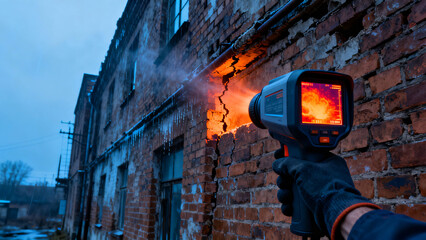
Executive Summary: Managing Aging Buildings — A Facility-Agnostic Approach
Organizations across sectors are confronting the challenge of aging buildings—facilities originally designed for service models, technologies, regulations, and populations that no longer reflect current realities. Shrinking capital budgets, rising operational expenses, and rapidly changing user needs mean that the question “Build, Renovate, or Demolish?” requires more than a basic condition assessment. It demands a strategic, holistic evaluation of asset value, adaptability, and long-term costs and benefits.
Modern buildings must support new workflows, enhanced safety expectations, evolving regulatory frameworks, and technologies that accelerate or disrupt service delivery. Many aging structures struggle with inefficiencies, including outdated layouts, high operational and maintenance costs, space that no longer meets user needs, and infrastructure not designed for contemporary systems or codes. As a result, organizations must analyze not just physical condition but also utilization, operational patterns, space efficiency, movement costs, safety, compliance, and strategic alignment.
A Strategic Facility Assessment (SFA) extends traditional metrics like the Facility Condition Index (FCI) and Age of Plant Index (AOPi) by integrating operational indicators, organizational strategy, and future demand forecasts. Only by understanding the true value and limitations of current assets can leaders evaluate the trade-offs among building new, renovating, repurposing, or demolishing.
There is no one-size-fits-all answer. Most organizations ultimately pursue a hybrid solution, combining new construction, targeted renovation, asset repurposing, and selective demolition. The goal is not to preserve aging buildings but to optimize total asset performance and future adaptability while respecting financial constraints.
The following decision tree visually outlines the core decision-making path organizations can use to evaluate aging buildings.
Managing Aging Buildings: A Strategic, Data-Driven Approach to Modernizing Aging Assets
Across every sector—public, private, industrial, and commercial—organizations are confronting the same difficult question: What should we do with our aging buildings? Whether the structure is a decades-old administrative facility, a campus building, a high-occupancy arena, or a specialized operational site, leaders must decide whether to build new, renovate, repurpose, monitor, or demolish. Each option carries significant financial, operational, regulatory, and safety implications.
Aging buildings are more than an infrastructure issue—they are a strategic asset challenge. The decision to invest, divest, or rebuild must be informed by both traditional facility assessments and modern structural monitoring technologies that reveal how a building truly performs over time.
This article provides a facility-agnostic framework for evaluating aging assets, integrating classical lifecycle planning with real-time structural health monitoring (SHM), operational efficiency analysis, and long-term risk management.
1. Why Aging Buildings Demand a New Strategic Lens
Buildings designed decades ago often struggle to support evolving needs, including:
• New technologies and system loads
Modern networks, digital infrastructure, energy systems, and mechanical and electrical demands often exceed the original design capacity.
• Evolving user groups and service delivery models
Space types, accessibility requirements, safety standards, and workflow patterns shift over time.
• Increased regulatory and safety expectations
Seismic codes, wind performance criteria, occupancy regulations, and industry-specific standards are more stringent than ever.
• Rising cost pressures
Buildings are typically one of the largest organizational expenses after personnel. Inefficient or obsolete facilities create ongoing operational burdens, from energy use to fragmented operations across multiple satellite properties.
• Environmental and climate exposure
Structures in regions prone to hurricanes, high winds, earthquakes, or high-moisture conditions face accelerated deterioration and higher safety expectations.
As a result, organizations must navigate not just how old a building is but how well it performs today, how safely it performs under stress, and how cost-effective it will be tomorrow.
2. Step One: Assess What You Have—Strategically and Technically
Traditionally, owners rely on metrics such as:
- Facility Condition Index (FCI)
- Age of Plant Index (AOPi)
- Standard Facility Condition Assessments (FCA)
These are necessary but insufficient. They describe condition—not value, risk, or strategic relevance.
A comprehensive approach requires a Strategic Facility Assessment (SFA) that integrates:
A. Physical & Infrastructure Characteristics
- Structural condition
- Mechanical, electrical, plumbing, and IT system capacity
- Floor-to-floor height and ability to expand systems
- Deferred maintenance costs
- Environmental vulnerabilities
B. Operational Efficiency & Cost
- Energy consumption
- Staffing and maintenance burden
- Redundant utilities across multiple properties
- Costs of moving people or operations between inefficient layouts
- Occupancy levels vs. actual capacity
- Workflow disruption caused by outdated design
C. Asset Utilization & Portfolio Integration
- Are buildings fully used or underutilized?
- Can sites be consolidated?
- Are certain properties suitable for sale, lease, or repurposing?
- What is the market value of supplemental or satellite properties?
D. Connectivity & Technology Infrastructure
- Network integration: Is the building connected to the primary fiber backbone?
- Monthly fees for independent connectivity
- Impacts of older construction methods on wireless and wired signal penetration
E. Safety, Regulatory, and Functional Compliance
- Adherence to current safety codes
- Suitability for current and future use cases
- Requirements for upgrades before changing occupancy types or functions
This level of analysis reveals the true cost and true value of an aging asset—not just its physical condition.
3. Step Two: Use Data—Not Assumptions—to Explore Options
Once data is collected, organizations can evaluate four primary strategies:
Option A: Renovate
Renovation is attractive when the structural “bones” are good, infrastructure is adaptable, and costs remain below replacement costs. However, several factors must be considered:
- Will renovations last 7–10 years or 30–40 years?
- Are there functional limitations that modernization cannot overcome?
- Will renovation significantly disrupt operations?
- Can phasing be executed without overly burdening staff or customers?
Option B: Build New
Building new becomes viable when:
- The existing structure cannot meet future operational needs.
- Technology or safety requirements exceed retrofit capabilities.
- The long-term lifecycle costs of renovation approach or exceed those of new construction.
Key considerations:
- Land availability and zoning
- Transition costs and operational continuity
- Stakeholder and community expectations
- Future-proofing designs for unknown technologies
Option C: Repurpose
Repurposing works when a building is structurally sound but no longer aligned with its original purpose. Examples include:
- Converting administrative spaces into community functions
- Moving high-demand operational units into more suitable facilities
- Shifting high-tech operations to modern buildings and reusing older buildings for low-tech or support functions
Option D: Demolish
Demolition is appropriate when:
- The building is functionally obsolete.
- Renovation costs exceed the building's value.
- Safety, seismic, or wind-load upgrades are cost-prohibitive.
- The site holds greater long-term strategic value than the structure.
Modern demolition may also recoup value through:
- Recycling metals, wiring, and structural materials
- Salvaging specialized equipment or heavy infrastructure
4. Adding a Modern Layer: Structural Health Monitoring (SHM)
Aging buildings are no longer assessed solely through visual inspections or periodic engineering reviews. High-impact environments—such as large public venues or buildings exposed to seismic or wind risks—benefit from continuous, real-time monitoring.
What SHM Adds
- Real-time tracking of structural movement, vibration, load, and drift
- Early warning of potential failures
- Data-driven insights into how crowds, machinery, or environmental conditions stress the structure
- Trend analysis for long-term maintenance planning
- Automatic alerts when thresholds are exceeded
- Regulatory compliance support
Why This Matters for Aging Buildings
SHM differentiates between a building that is merely “old” and one that is unsafe or under stress.
It also provides:
- Objective evidence to support renovation-versus-demolition decisions
- Insight into how the structure performs under maximum load (crowds, machinery, storms)
- Cost-saving opportunities by detecting minor issues before they escalate
For aging facilities in high-vibration or hazard-prone regions, SHM is becoming a best practice and, increasingly, a regulatory expectation.
5. Step Three: Compare Costs, Value, and Risk
After evaluating conditions and exploring options, organizations must compare:
- Capital investment
- Lifecycle costs
- Operational impact
- Transition and staffing implications
- Land, entitlement, zoning, and environmental costs
- Technology and infrastructure requirements
- Strategic alignment with future mission and demand
Importantly:
- Demolition costs cannot be capitalized—they hit the bottom line immediately.
- Renovation in occupied buildings often costs more due to phasing and disruption.
- New buildings require transition planning that temporarily increases staffing needs.
- Empty facilities create risk—security, decay, vandalism, and liability.
The best solution is rarely singular. Most organizations find value in hybrid strategies:
- Build new where necessary
- Renovate where feasible
- Consolidate or repurpose for efficiency
- Demolish strategically
- Deploy SHM for safety and long-term planning
6. Final Principle: Align Assets With Mission, Not the Other Way Around
Decisions about aging buildings are fundamentally strategic—not just operational or financial. The goal is not merely to preserve structures but to support the future direction of the organization.
The right decision must:
- Maintain safety
- Support evolving needs
- Reduce long-term costs
- Improve efficiency
- Enhance user experience
- Comply with regulations
- Mitigate risk
- Enable future growth or flexibility
No single model fits all. The strongest outcomes emerge when technical data, operational understanding, structural monitoring, and long-term strategy intersect.
Conclusion
Managing aging buildings requires more than maintenance—it requires a disciplined, data-driven, future-focused approach that integrates:
- Strategic facility assessment
- Operational efficiency and cost modeling
- Structural health monitoring
- Risk and regulatory evaluation
- Replacement, renovation, and demolition analysis
By combining strategic planning with modern diagnostics, organizations can confidently determine when to rebuild, when to renovate, when to repurpose—and when to let a building go.