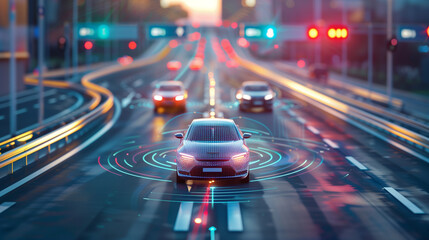
For more than a decade, autonomous driving has been just around the corner. From Tesla’s bold claims to Waymo’s meticulous road tests, self-driving cars have become symbols of both technological ambition and human hesitation. The question is no longer “Can machines drive?” but “Can the world adapt to machines driving?”
1. The Dream of Full Autonomy
The Society of Automotive Engineers (SAE) defines six levels of driving automation, ranging from Level 0 (no automation) to Level 5 (full automation).
- Level 2: Most current vehicles with driver-assistance features (e.g., Tesla Autopilot and GM Super Cruise).
- Level 3: Conditional automation—the car can handle some tasks but requires a human fallback.
- Level 4: High automation—limited to specific areas (e.g., Waymo’s driverless taxis in Phoenix).
- Level 5: Full automation—the car drives anywhere, anytime, and under any conditions.
Despite billions in R&D, we’re stuck between Levels 2 and 3. The “last 10%” of automation—unpredictable conditions, ethical dilemmas, and human unpredictability—remains a monumental challenge.
2. Why the Road to Autonomy Is So Hard
a. The Edge Case Problem
AI learns from data. But no amount of data can account for every “What if?” scenario: a child running after a ball, a plastic bag mistaken for debris, or a police officer waving you through a red light. These edge cases make driving one of the most complex real-world AI problems ever.
b. The Human Context
Driving isn’t just physics; it’s psychology. Humans infer intent through subtle cues—a moment of eye contact, a wave, or hesitation at a crosswalk. Machines lack this nuanced social intelligence.
c. Regulation and Liability
Who’s responsible in an accident—the driver, the carmaker, or the algorithm? Without global regulatory frameworks, Level 5 cars remain legally and ethically stranded.
d. Infrastructure Gaps
Even the most advanced sensors can’t fix potholes, faded lane markings, or chaotic traffic, especially in emerging markets like India, where unpredictability is the norm.
3. Progress: From Labs to Limited Lanes
Despite the hurdles, autonomy is not dead—it’s evolving in practical directions.
- Waymo and Cruise operate robotaxis in limited U.S. cities, though recent safety concerns have slowed expansion.
- Mercedes-Benz became the first automaker to obtain Level 3 certification for U.S. roads in 2023 (Drive Pilot in California and Nevada).
- Truck platooning and autonomous logistics are quietly transforming freight transport—safer, more predictable, and less politically sensitive than passenger cars.
- AI copilots are redefining driving assistance through lane-keeping, adaptive cruise control, and parking assistance, inching toward partial autonomy rather than full replacement.
4. The Likely Future: Co-Pilots, Not Chauffeurs
Autonomous driving is unlikely to appear as a sudden leap. Instead, it will be a continuum of semiautonomous experiences that integrate more deeply over time.
- 2025–2030: Expansion of Level 3 systems on highways; truck and shuttle automation in controlled environments.
- 2030–2040: Urban networks for autonomous fleets in select cities; AI copilots that adapt to driver behavior.
- Beyond 2040: True Level 5 autonomy—but only in highly mapped, fully connected smart cities.
Humans won’t vanish from the driver’s seat; they’ll simply have smarter partners.
5. Ethics, Trust, and the Human Factor
For many, the roadblock isn’t technical—it’s emotional. Surveys show that over 70% of drivers say they wouldn’t feel safe in a fully autonomous car. Trust, once broken by crashes or AI malfunctions, is slow to rebuild.
The future of autonomy will depend as much on public trust and moral design as on LiDAR and neural networks.
6. So—Will It Ever Happen?
Yes, but not the way Silicon Valley once promised.
Autonomous driving will emerge unevenly, coexist with human drivers for decades, and redefine what “driving” means rather than eliminate it.
The revolution won’t be a single moment; it’ll be a slow-motion transformation in which algorithms quietly take over one human reflex at a time.
In the end, the question may not be “Will autonomous driving happen?” but “Will we recognize it when it does?”
References (Chicago Style)
- Society of Automotive Engineers (SAE), Taxonomy and Definitions for Terms Related to Driving Automation Systems for On-Road Motor Vehicles (SAE J3016, 2021).
- Elon Musk, “Tesla AI Day Keynote,” Tesla, Inc., August 2023.
- Waymo Safety Report, On the Road to Fully Self-Driving (Alphabet, 2022).
- Mercedes-Benz USA, Drive Pilot Regulatory Approval Announcement, 2023.
- RAND Corporation, Autonomous Vehicle Technology: A Guide for Policymakers, 2020.
- McKinsey & Company, “The Road to Autonomous Trucking,” 2023.