For more than 20 years, I've helped businesses compete for government and corporate contracts. My firm, nDemand Consulting Services, has contributed to more than $1.8 billion in awarded federal contracts within the last three years alone. I thought I knew what separated the businesses that win from those that don't.
Then we built the C3PI readiness assessment and watched 312 small businesses take it. I learned more about how small businesses make decisions in two months than I had in two decades.
Ambition Was Never the Problem
The businesses in our data weren't short on drive. A large share of them wanted both government and corporate contracts. They had big goals, real products, and owners willing to work around the clock.
But when we looked at how they scored, a pattern jumped off the page. The same businesses reaching for the biggest opportunities scored lowest on governance and basic systems. And those are the very things buyers check first.
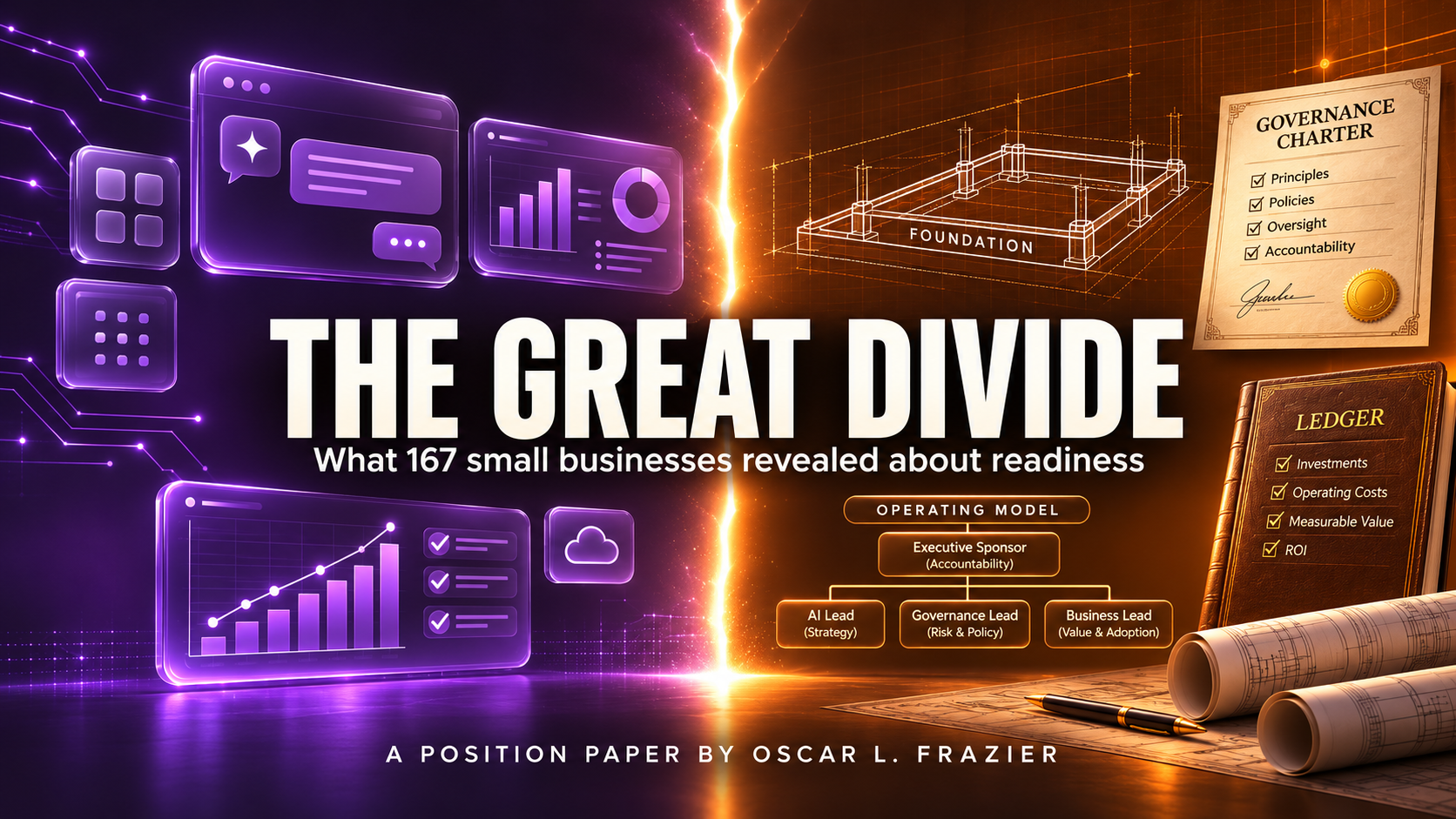
That's the great divide. It isn't a talent gap. It's the distance between wanting growth and being built for it.
What Buyers Actually Look For
When a procurement team evaluates a supplier, they're asking one question underneath every form: Can this business deliver at volume without breaking? They want to know who makes decisions, how work gets done when the owner isn't in the room, whether the finances can carry a contract that pays in 30, 60, or 90 days, and whether there's a track record they can verify.
None of that is glamorous. It's the boring work. And it's exactly the work most small businesses put off with the same sentence: We'll build it once we win. The problem is that the award goes to the business that has already built it.
Readiness Is a Decision
What surprised me most is that readiness is less about resources than it is about decisions. Every business in our data made choices about where to spend its time. The ones that scored well had decided early that structure was part of the product. They documented how they work. They put governance in place before anyone required it. They treated basic systems as the foundation for growth instead of an obstacle to it.
That's a lesson for life as much as for business. Opportunity rarely gives you a heads-up. When it shows up, you're either ready or you're watching someone else take your seat.
Where AI Fits, and Where It Doesn't
We're in a moment when AI can help close this gap faster than ever. It can organize documents, draft responses, flag weaknesses, and help a small team operate like a much larger one. I build with these tools every day, and I believe in them.
But I also believe the businesses that win next will be the ones that keep people at the center of the decisions that matter. Buyers don't award contracts to software. They award them to people they trust to deliver. That's the heart of my TEDx talk, What Lasts Is What Stays Human. Automation can make you faster. It can't make you trustworthy. Only the humans in your business can do that.
Three Moves to Cross the Divide
Get an honest baseline. You can't fix what you won't measure. Find out where your business truly stands on governance, systems, finances, and past performance before a buyer does it for you.
Build the boring things first. Decision rights, documented processes, financial controls, and a clean record of your work. These aren't paperwork. They're proof that you can take on volume.
Keep humans at the decision points. Use technology to move faster, but make sure the relationships, judgment calls, and accountability stay with people.
The divide is real, but it isn't permanent. Every business that's ready today was once a business that decided to get ready. The question is whether you'll make that decision before the opportunity shows up or after it's gone.
Oscar L. Frazier is the Founder and CEO of nDemand Consulting Services and Co-Founder and CEO of C3PI. His book, The Great Divide, is available on Amazon, and you can watch his TEDx talk, What Lasts Is What Stays Human, on YouTube.