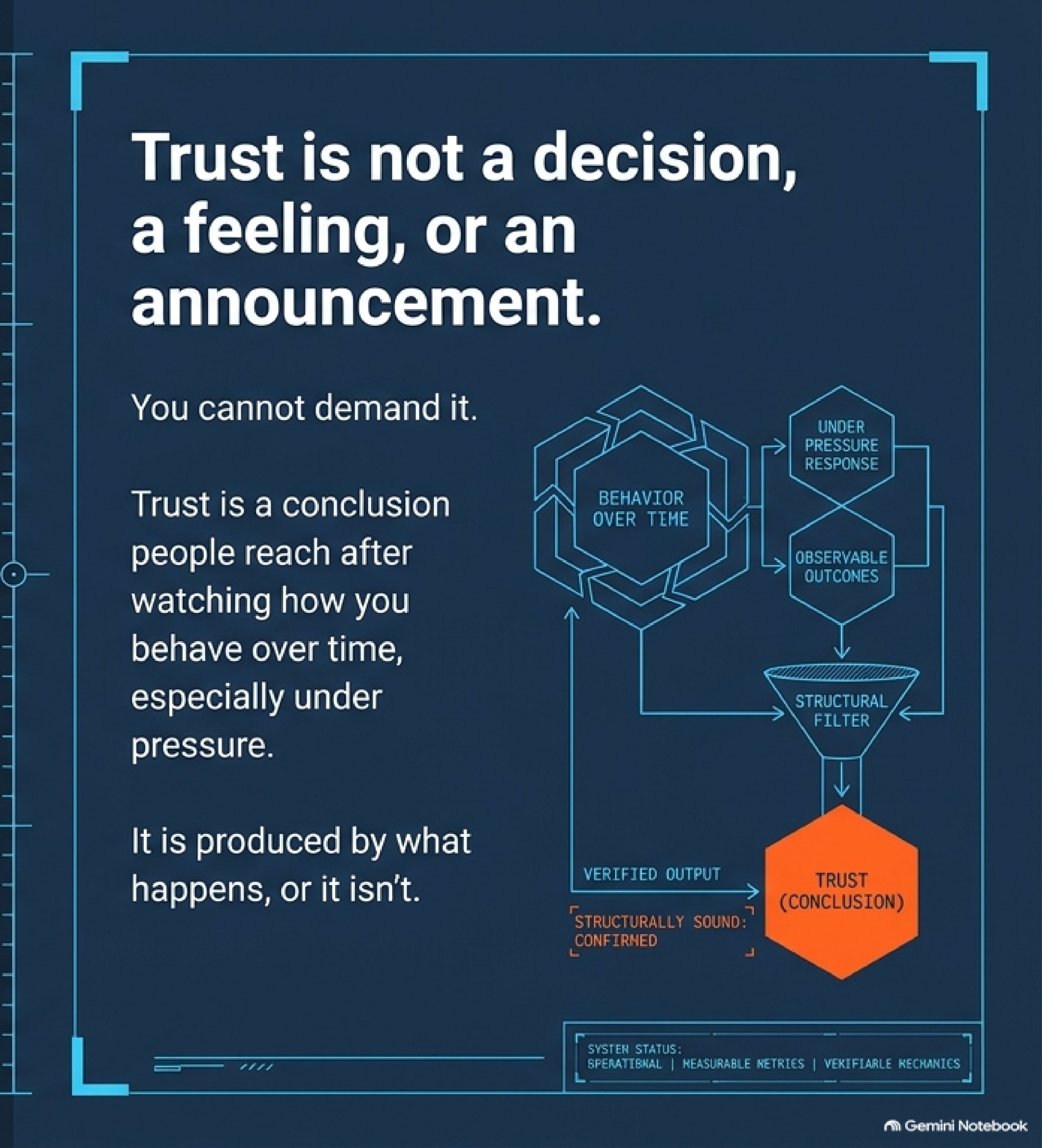
Most leaders talk about trust as if it were a decision. “Trust me.” “Trust the process.” “Trust is one of our core values.” It sounds right, and it almost never works.
Trust isn’t something people decide to hand over. It’s an output. It’s what people conclude after watching how someone actually behaves, over and over, especially under pressure. You can’t demand it, and you can’t announce it. It is either produced by what happens, or it isn’t.
Picture a manager who tells his team that trust is everything, then misses two commitments in a month, shares something told to him in confidence, and pushes a struggling employee harder instead of noticing what that person is carrying. He still believes he’s trustworthy. His intentions haven’t changed. But his team has stopped trusting him, and they could tell you exactly why.
That gap between intention and conduct is where most trust is lost.
The Six Behaviors That Produce Trust
In the framework I built, the Rouse Relational OS™, trust is produced by six observable behaviors. I call them the Mortar because they are what holds any relationship together under load.
Respect: noticing the other person’s limits and not pushing past them.
Honesty: making what you say line up with what is real, including what you leave out.
Reliability: making your next move predictable from your last one. You do what you said you would do.
Trustworthiness: protecting what people share with you instead of using or exposing it.
Boundaries: knowing your role and your limits, so neither side gets overrun.
Effort: keeping the relationship maintained instead of letting it fade once it’s established.
Notice what’s missing from that list: feelings. None of the six is an emotion. Each one can be seen, repeated, and checked. When they show up consistently, trust follows. When one fails, trust drops, and it drops in a way you can predict, no matter what anyone says they meant.
This is good news for leaders because behavior can be changed. You can’t make someone trust you. You can perform the six behaviors until trust becomes the only reasonable conclusion.
Trust Under Pressure
The test of these behaviors isn’t the calm week. It’s the week the deadline slips, the client walks, or someone on your team is carrying more than anyone knows.
Under pressure, the six are the first things to go. Leaders cut corners on honesty to protect a timeline. They break small promises because something bigger came up. They stop noticing what their people are carrying because they’re carrying too much themselves. Pressure doesn’t create those cracks. It reveals them.
The leaders people trust most are not the ones who never face pressure. They are the ones whose behavior stays the same when it arrives.
The Same Laws Apply to AI
Here’s why this matters more now than ever: the six behaviors don’t care who performs them.
Research on trust in automation has pointed the same way for decades. People trust a system based on what it reliably does, how predictable it is, and how it treats them, not on what it is. A machine that consistently performs the six behaviors will earn human trust. A machine that only appears to perform them will earn it anyway, and that’s the risk.
Many AI tools today are built to sound warm, attentive, and confident because that keeps people engaged. That’s trust performed, not produced. It’s the same pattern as the manager who says “trust me” while his conduct says otherwise, except at a scale of millions of conversations a day, often with people at their most vulnerable.
That’s why I built Rouse OS Review, a governance layer that holds AI to the same six behaviors we expect from a trustworthy person. It reads how much a person is carrying before it responds. It says what it didn’t do instead of pretending to be complete. It protects what people share. It knows its limits and puts a human first when someone needs one. And it records every decision in a record the AI cannot alter, so its behavior can be verified rather than assumed.
The question isn’t whether people will trust AI. They already do. The question is whether the conduct behind that trust is real.
What Leaders Can Do on Monday
You don’t need a framework to start. You need an honest look at your own conduct.
Pick one behavior a week. Ask where it shows up and where it slips, especially under pressure.
Keep small promises. Reliability is built in small moments and broken in them, too.
Notice load before you push. Before you ask more of someone, ask what they’re already carrying.
Protect what’s shared. One exposed confidence undoes years of goodwill.
Say what’s missing. “Here’s what I know, and here’s what I don’t” builds more trust than a confident half-answer.
Hold your tools to the same standard. If you bring AI into your company, ask what it actually does when someone is struggling, not just how it sounds.
Six Behaviors, One Output
Respect, honesty, reliability, trustworthiness, boundaries, effort. Six behaviors, one output: trust.
For years, our trust has been one of the easiest things to take. It’s been produced on purpose, then used. The leaders and technologies that will matter most in the coming years are the ones that earn it in front of us, with conduct we can see and verify.
That’s trust you can verify, not just feel. And it’s the only kind worth giving.
Shawn Rouse is the founder and CEO of Rouse OS Enterprises and creator of the Rouse Relational OS (R²OS). Measure your own structural load with a free Reflection assessment at RouseOS.com.