The Skilled Trades: A Smarter Career Move for Young Men
Most of the men reading this were told the same thing growing up: go to college, get the degree, and the rest will take care of itself. Many of us are now passing that same advice down to our sons, our nephews, and the young men we mentor.
It's time to rethink it. The skilled trades are no longer the fallback. For the right young man, they may be the smartest career move available, and the men in the best position to point him in that direction are often the ones who never mention it.
The Numbers Don't Lie
America is running short on the people who keep it running. Construction alone needs an estimated 349,000 net new workers in 2026. Add in retirements and the race to build data centers, and the broader skilled-trades shortage tops 1.3 million workers.
The pay reflects the demand. Bureau of Labor Statistics data from May 2025 puts the median annual wage for electricians at $63,190, plumbers at $63,800, and HVAC technicians at $61,010, compared with $50,980 for all U.S. jobs. The top 10% of electricians earn more than $108,000.
And most of those men got there without accumulating a mountain of student debt. While their peers spent four years paying for a degree, apprentices were getting paid to learn.
Why Young Men Aren't Showing Up
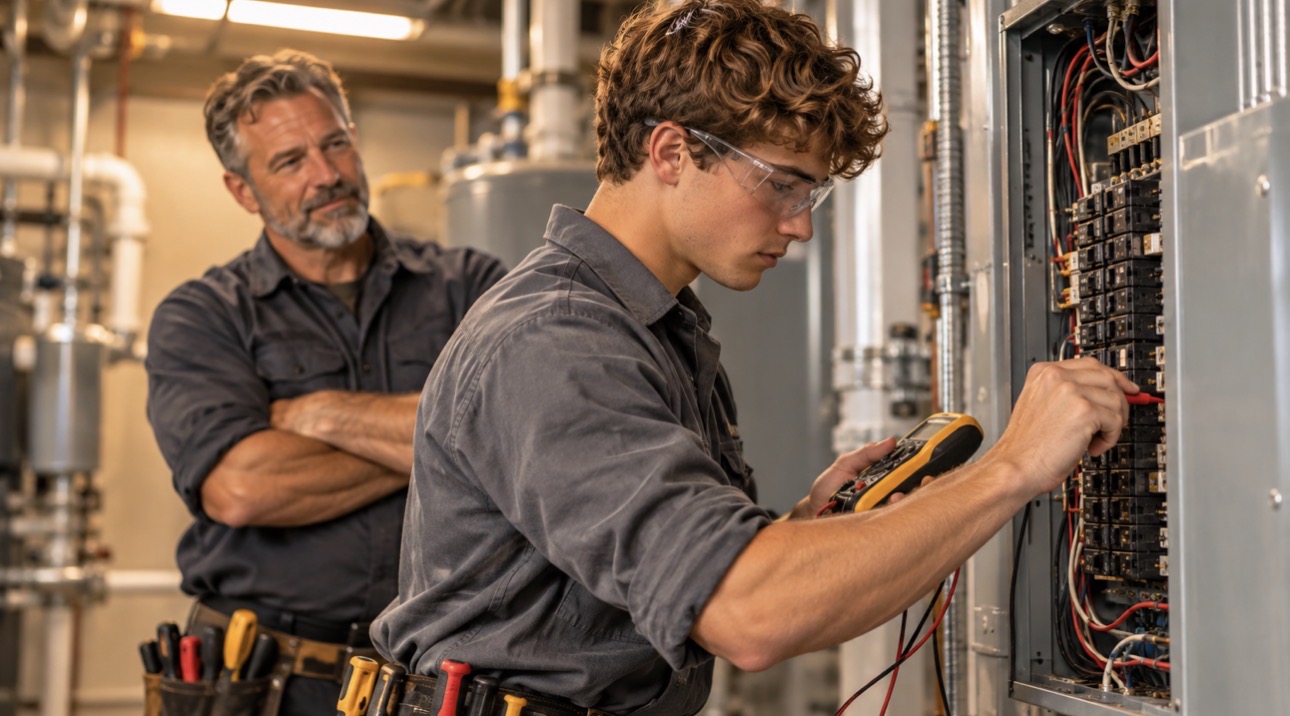
Part of it is image. Somewhere along the way, the trades got branded as dirty, dead-end work. Anyone who has watched a master electrician trace a fault through a building or an HVAC technician bring a failing system back from the brink knows better. That's high-level problem-solving with real consequences.
Part of it is that nobody shows them the path. Counselors push college because it's what they know. Parents want something "better" for their kids without realizing this might be it. And young men rarely get to see the ceiling: the superintendent, the facilities director, or the contractor who started as an apprentice and now signs the paychecks.
The result is a generation of skilled workers heading into retirement with no one ready to take the keys.
The Ones Who Learn Both Will Lead
The trades aren't standing still. Today's buildings run on automation systems, digital work orders, and sensors that flag a problem before anyone notices it. AI is moving in, too. It can sort data, spot patterns, and build a maintenance schedule.
What it can't do is feel a motor running hot, hear a pump starting to fail, or know what a strange smell in the mechanical room means. Real buildings are never as tidy as a screen suggests.
That gap is the opportunity. The next leaders in the field won't be the ones who only know the tools or only know the technology. They'll be the ones who can turn a wrench in the morning and read a dashboard in the afternoon. And they'll be able to name their price.
What You Can Do About It
If you're a father, a mentor, or a leader who hires, you have more influence here than you think:
- Talk about the trades with respect. Young men notice how successful men talk about the work. If you treat it as a lesser path, so will they.
- Show them the ceiling. Introduce them to the tradesman who now owns the company or runs the facility. Seeing it makes it real.
- Point them toward paid training. Apprenticeships and entry-level maintenance roles at hospitals, property management firms, and senior living communities can provide on-the-job training for willing workers.
- Push credentials and the business side. Certifications can raise pay. Understanding budgets, vendors, and compliance is what turns a technician into a leader.
- Be the mentor. One man who takes a chance on a young man can change the course of his life. I know because someone did it for me.
There's Dignity in This Work
Every hospital, school, apartment complex, and senior living community in America depends on someone who knows how to keep the lights on, the water running, and the air clean. When those people are gone, nothing else works.
There's a quiet dignity in being that person. The work is real, the results are visible at the end of every day, and the skills can't be outsourced, automated, or taken away.
So, the next time a young man asks you what he should do with his life, don't hand him the backup plan. Hand him the blueprint. For the right man, the trades aren't where he ends up when nothing else works out. They're where everything starts.