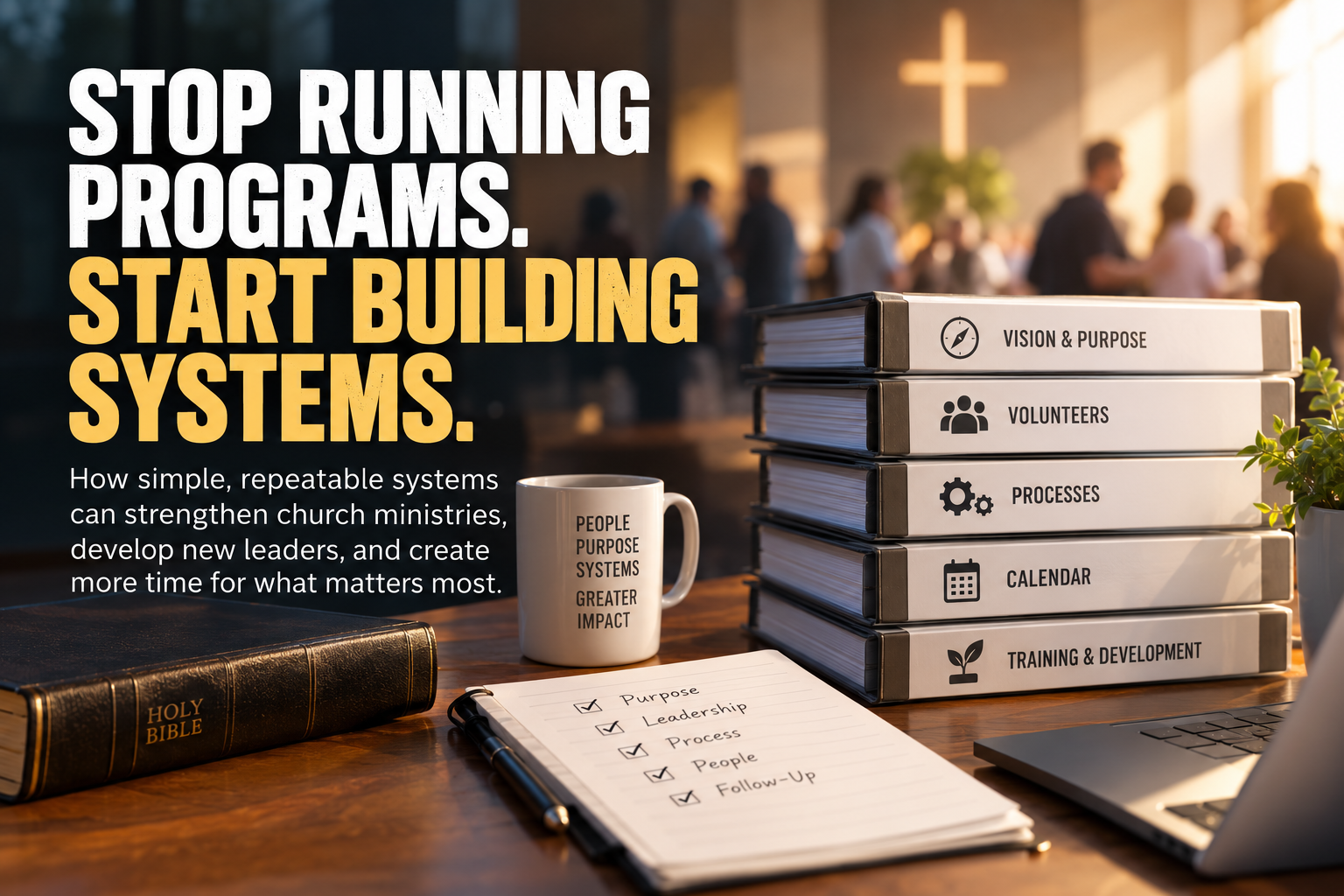
Churches are full of good people doing good things.
Sunday school classes. Children’s ministry. Men’s and women’s groups. Community outreach. Vacation Bible School. Small groups. Mission projects. Fellowship meals. Hospital visitation. Holiday programs.
And behind many of those ministries is usually somebody working harder than everyone realizes.
They know where the supplies are kept. They know who has the key. They know who normally brings the food. They remember when the announcement needs to go in the bulletin. They know which volunteer has to be reminded twice and which one will show up thirty minutes early.
Then one Sunday, that person gets sick.
And suddenly, nobody knows what to do.
That isn’t necessarily a people problem. It may be a systems problem.
After years of leadership in ministry and business, I have become convinced that one of the most overlooked responsibilities of leadership is building systems that allow good people to do good work consistently.
A system doesn’t replace ministry. It supports it.
A Good Program Can Still Have a Bad System
Churches sometimes resist words like systems, processes, procedures, and organization because they sound too much like business.
I understand that concern. The church is not a corporation.
But organization isn’t unspiritual.
Paul wrote:
“But all things should be done decently and in order.”
— 1 Corinthians 14:40
Think about Jesus feeding the five thousand.
There was a miracle, certainly. But there was also organization. Jesus instructed the people to sit in groups. The disciples distributed the food. Afterward, the leftovers were collected.
The miracle didn’t eliminate the need for organization.
In Acts 6, the early church encountered another organizational problem. Certain widows were being overlooked in the daily distribution of food. The apostles didn’t simply tell everyone to try harder.
They changed the structure.
Qualified people were selected and given responsibility so the ministry could be handled faithfully while the apostles remained focused on prayer and the ministry of the Word.
That’s system building.
And notice the result:
“And the word of God continued to increase, and the number of the disciples multiplied greatly in Jerusalem.”
— Acts 6:7
Good organization served the mission.
If Only One Person Knows How It Works, You Don’t Have a System
This is where many church programs become vulnerable.
Ask a simple question:
What happens if the person leading this ministry is gone for six weeks?
Can someone else step in?
Does anyone know what needs to happen?
Are the important dates written down?
Is there a budget?
Is there a volunteer list?
Does anyone know the passwords, procedures, contacts, suppliers, or expectations?
Or does all of that information live inside one person’s head?
When ministry depends entirely upon one person, eventually that person becomes exhausted, frustrated, or indispensable.
None of those outcomes is healthy.
The goal of leadership shouldn’t be to make ourselves indispensable.
It should be to build something that can continue faithfully without us.
Every Church Ministry Needs Five Things
Systems don’t have to be complicated. In fact, complicated systems usually don’t survive very long in volunteer organizations.
A healthy ministry system can begin with five simple questions.
1. What is the purpose?
Every ministry should be able to complete this sentence:
This ministry exists to…
If nobody can clearly explain why a program exists, it may be surviving simply because “we’ve always done it.”
Tradition can be valuable. But tradition should carry the mission forward, not replace it.
2. Who owns it?
Someone needs responsibility.
Not responsibility for doing everything, but responsibility for making sure everything gets done.
There is a difference.
Strong leaders don’t collect tasks. They coordinate people.
3. What happens repeatedly?
Write it down.
If the same things happen every week, month, quarter, or year, create a simple checklist.
For example, a monthly fellowship meal might require:
- Confirming the date and location
- Identifying the coordinator
- Recruiting volunteers
- Purchasing supplies
- Promoting the event
- Setting up
- Cleaning up
- Following up with guests
None of that is revolutionary.
That’s exactly the point.
A good system takes things we repeatedly have to remember and turns them into things we no longer have to remember.
4. Who is being developed?
Every ministry leader should have someone learning beside them.
Moses had Joshua.
Elijah had Elisha.
Paul had Timothy.
Jesus invested deeply in twelve disciples who would eventually carry the mission without His physical presence among them.
Church leadership was never intended to be a collection of permanent jobs guarded by the people who currently hold them.
Leadership should reproduce leadership.
Ask every ministry leader:
Who could do what you do if you couldn’t do it anymore?
If the answer is “nobody,” you’ve just identified something that needs attention.
5. How will we know whether it’s working?
Churches sometimes mistake activity for effectiveness.
“We had the program.”
That’s not necessarily success.
Did anybody grow spiritually?
Did anyone new become involved?
Did we serve the community?
Did relationships deepen?
Did volunteers develop?
Did the ministry advance the church’s mission?
Not everything important can be measured with numbers. But everything we do can be evaluated.
Build Systems Around People, Not People Around Systems
There is another danger.
We can become so focused on organization that the system becomes more important than the people it was created to serve.
That’s backwards.
Jesus said:
“The Sabbath was made for man, not man for the Sabbath.”
— Mark 2:27
The same principle applies here.
Systems are servants.
They should make ministry easier, clearer, safer, and more sustainable.
When a system stops serving people and starts controlling them, change the system.
That’s one reason I favor simple systems.
One page is usually better than twenty.
A checklist people actually use is better than a manual nobody reads.
Clear responsibility is better than another committee meeting.
And a five-minute conversation can sometimes solve what twenty emails cannot.
The Bus Test
Here’s a question I have used in different leadership settings.
It sounds a little morbid, so perhaps we should rename it someday, but it makes the point.
What happens to your ministry if you get hit by a bus tomorrow?
Would everything stop?
Would someone spend three weeks trying to figure out what you were doing?
Or could another leader open a folder, look at the calendar and checklist, make a few phone calls, and keep the ministry moving?
That’s not about making people replaceable.
People aren’t replaceable.
But roles should be transferable.
There is a big difference.
Pastors Need Systems Too
Pastors can be some of the worst offenders.
We answer every question.
We make every decision.
We know every password.
We keep the calendar in our heads.
We personally solve every problem.
At first, it can feel like good leadership.
Eventually, it becomes a bottleneck.
Moses discovered this in Exodus 18. He was sitting from morning until evening hearing the people’s disputes. His father-in-law, Jethro, watched what was happening and essentially told him:
This isn’t sustainable.
“What you are doing is not good. You and the people with you will certainly wear yourselves out.”
— Exodus 18:17–18
Notice that Moses’ problem wasn’t laziness.
It was the opposite.
He was doing too much.
Jethro’s solution was structure, delegation, and leadership development.
Moses would continue handling what only Moses could handle. Other capable leaders would carry appropriate responsibilities.
That’s still good advice.
Start Small
You don’t need expensive church-management software or a three-ring binder filled with policies to begin.
Pick one ministry.
Write down its purpose.
Identify the leader.
List the recurring tasks.
Put the dates on a calendar.
Identify one backup person.
Create a basic checklist.
Then ask:
What are we doing repeatedly that shouldn’t require us to reinvent the wheel every time?
Fix that first.
Then move to the next thing.
Over time, something begins to happen.
Chaos decreases.
Communication improves.
New leaders emerge.
Volunteers know what is expected.
Pastors stop carrying things they were never supposed to carry alone.
And ministry becomes more sustainable.
Systems Should Free Us to Do Ministry
The goal isn’t to turn the church into a machine.
Quite the opposite.
Good systems handle the predictable things so people have more time for the unpredictable things.
People don’t schedule cancer diagnoses.
Families don’t schedule crises.
A grieving widow doesn’t fit neatly onto a ministry calendar.
The teenager who finally decides to talk about what’s happening at home doesn’t care about your administrative procedures.
Those moments require people.
Presence.
Prayer.
Compassion.
Time.
That’s why systems matter.
Every hour we spend unnecessarily reinventing routine work is an hour we cannot give somewhere else.
Build the checklist.
Train the backup.
Share the responsibility.
Write down the process.
Then use the time you’ve saved to sit across the table from somebody who needs you.
Because ultimately, church systems aren’t about efficiency.
They’re about creating enough margin for ministry.
And ministry has always been about people.