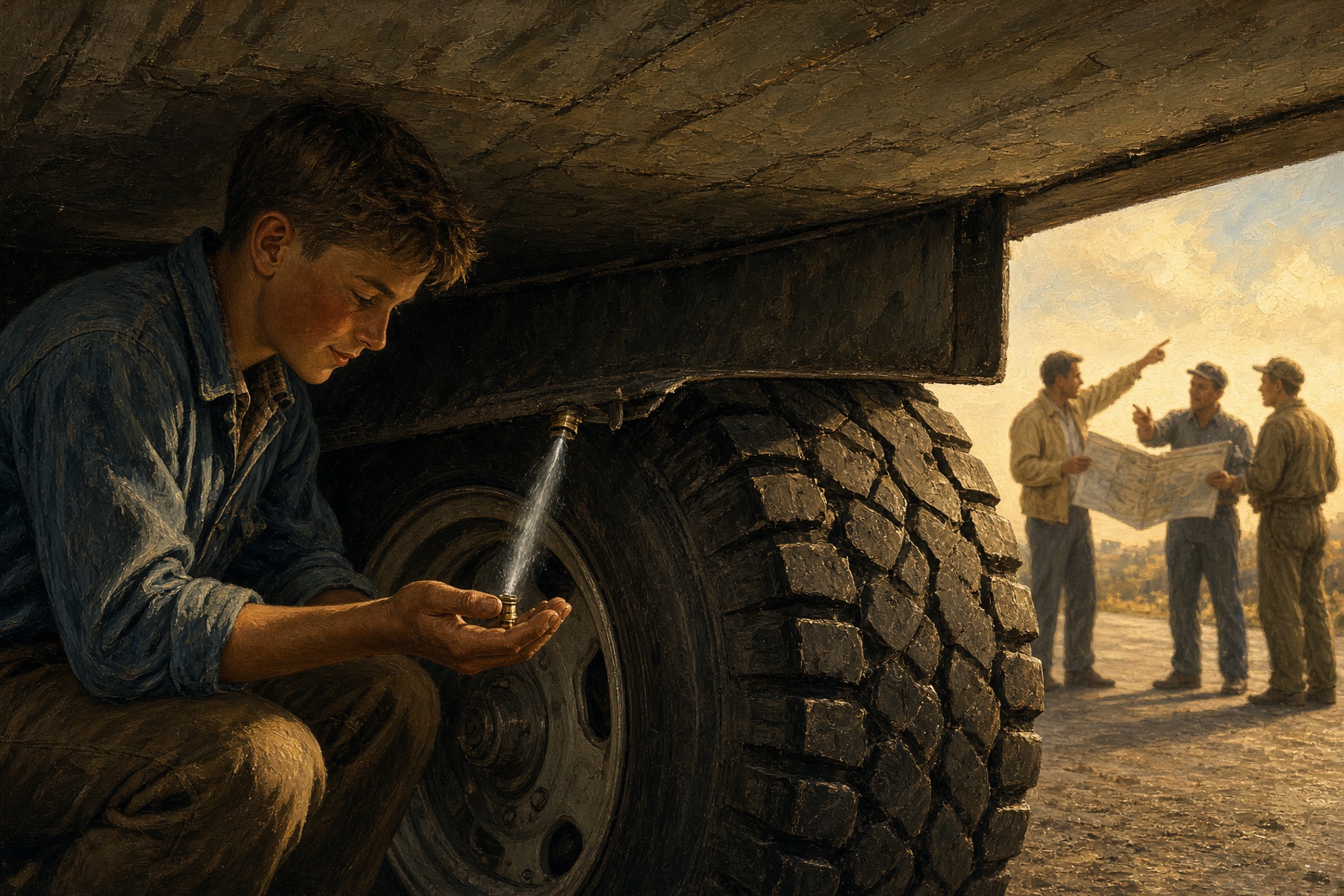
There is a classic parable that every systems engineer eventually learns, whether in a lecture hall or while standing on the asphalt watching a real-world mess unfold.
A semi-truck tries to drive under a concrete overpass. It misses the clearance by less than two inches and wedges itself underneath. Traffic backs up for miles. Within an hour, the experts arrive. Civil engineers pull out blueprints to see whether they can jackhammer the roadbed. Structural specialists debate bringing in cranes to lift the bridge deck. Equipment operators suggest cutting six inches off the top of the trailer. Every proposal is massive, destructive, and expensive.
While the specialists argue, a child sitting on the curb walks up to the police chief, looks at the truck, and asks, “Why don’t you just let the air out of the tires?”
They open the valves. The tires drop just enough. The truck rolls out. The bridge is untouched. The problem is solved in thirty seconds.
The Leadership Lesson
Every leader has stood in front of a wedged truck. A team that stopped delivering. A client relationship that’s stuck. A project that won’t move. Under pressure, our instinct is to bring in the jackhammers: more meetings, more process, more people, more money.
But most problems aren’t solved by adding force. They’re solved by changing the structure, by finding the one thing that’s too high for the clearance and lowering it. The child didn’t know more than the engineers. He just looked at the problem without assuming the answer had to be big.
Pressure doesn’t make us smarter. It makes us reach for complexity. The best leaders learn to stop, look down at the tires, and ask what simple structural change would let everything move again.
AI Safety Is Jackhammering the Bridge
Nowhere is this clearer right now than in AI.
When an AI system makes things up, drifts off course, or gives harmful advice to someone in distress, the industry’s reaction is to build bigger machinery: longer system prompts, more content filters, millions spent retraining models on edge cases, hoping the AI will learn to be safer. They are trying to fix the problem inside the same complex process that caused it.
They are ignoring the tire pressure.
Measure the Load First
In engineering, you don’t redesign the bridge to fit the truck. You check the clearance before the truck goes in. People work the same way. We are load-bearing systems. When life piles on pressure, whether from financial strain, a crisis at home, illness, or exhaustion, our capacity to take in information shrinks.
When a person in that state talks to an AI that pours out long, complex, multistep advice, it doesn’t help. It overloads them. The AI isn’t failing because it’s unkind. It’s failing because it can’t see how much the person on the other side is carrying.
The child’s answer to AI safety isn’t a smarter model. It’s measuring the person’s load before the AI responds and adjusting the response to fit.
That’s what the Rouse Relational OS (R²OS) does. Before the AI writes a word, it reads the person’s Net Load Index (NLI), a measure of how much structural load they are carrying, produced by the Rouse OS Equation (ROSE). When load is low, the AI works normally. As load rises, it says less and asks less, keeps decisions simple, and still does the work the person asked for. At the highest load, it puts the person’s connection to a real human being first. And every response is checked against those rules before it reaches the person.
You don’t need a bigger supercomputer to keep AI from overwhelming someone in crisis. You need to lower the height of the conversation to match the clearance they actually have.
Built Under Pressure
There is a reason this simple idea was easy to miss. When you work inside well-funded institutions with unlimited resources, the instinct is to add: more parameters, more code, more complexity.
R²OS wasn’t designed on a corporate campus. It was written on a mobile phone while recovering from a traumatic brain injury and living on the street, under the kind of pressure most system designers only read about. When you’re surviving with no margin for error, you don’t have the luxury of overengineering. You strip away the noise and look at the mechanics underneath.
From there, I came to see stress not as a vague feeling but as a structural load that can be measured. That work has become a full body of work consistent with decades of research:
- The Unwritten Syllabus, the core book on the hidden blueprints of healthy relationships.
- The Net Load Index and the Rouse OS Equation, a way to measure structural load.
- Rouse OS Review, a patent-pending AI governance layer now being integrated with an AI mental-health app.
- A three-tier practitioner certification and a 16-week curriculum.
The Answer Was on the Ground
Right now, much of the AI industry is standing around a wedged truck, arguing over jackhammers and spending billions trying to fix safety after the fact.
The answer was never to rebuild the bridge. It was to look at the ground, measure the real clearance, and let some air out of the tires before driving through.
Sometimes it takes the person standing on the asphalt, the one who knows what heavy pressure actually feels like, to point at the tires and show everyone how simple the fix can be.
Shawn Rouse is the founder and CEO of Rouse OS Enterprises and creator of the Rouse Relational OS (R²OS), a structural framework for relationships and a patent-pending AI governance architecture. Measure your own structural load with a free Reflection assessment at RouseOS.com.