Keep It in the Green: The Safety Culture Every Helicopter Pilot Should Take into Retirement
By Nick Mayhew
Why do the habits that keep helicopter pilots safe in the cockpit matter just as much throughout a lifetime in aviation—and beyond?
Introduction: Safety Is a Mindset, Not a Flight Manual
For helicopter pilots, safety has never been simply a matter of knowing the aircraft, understanding its limitations, or completing the required checks before flight. It is a way of thinking, a set of personal standards, and a willingness to make the right decision, even when that decision is inconvenient, unpopular, or difficult to explain.
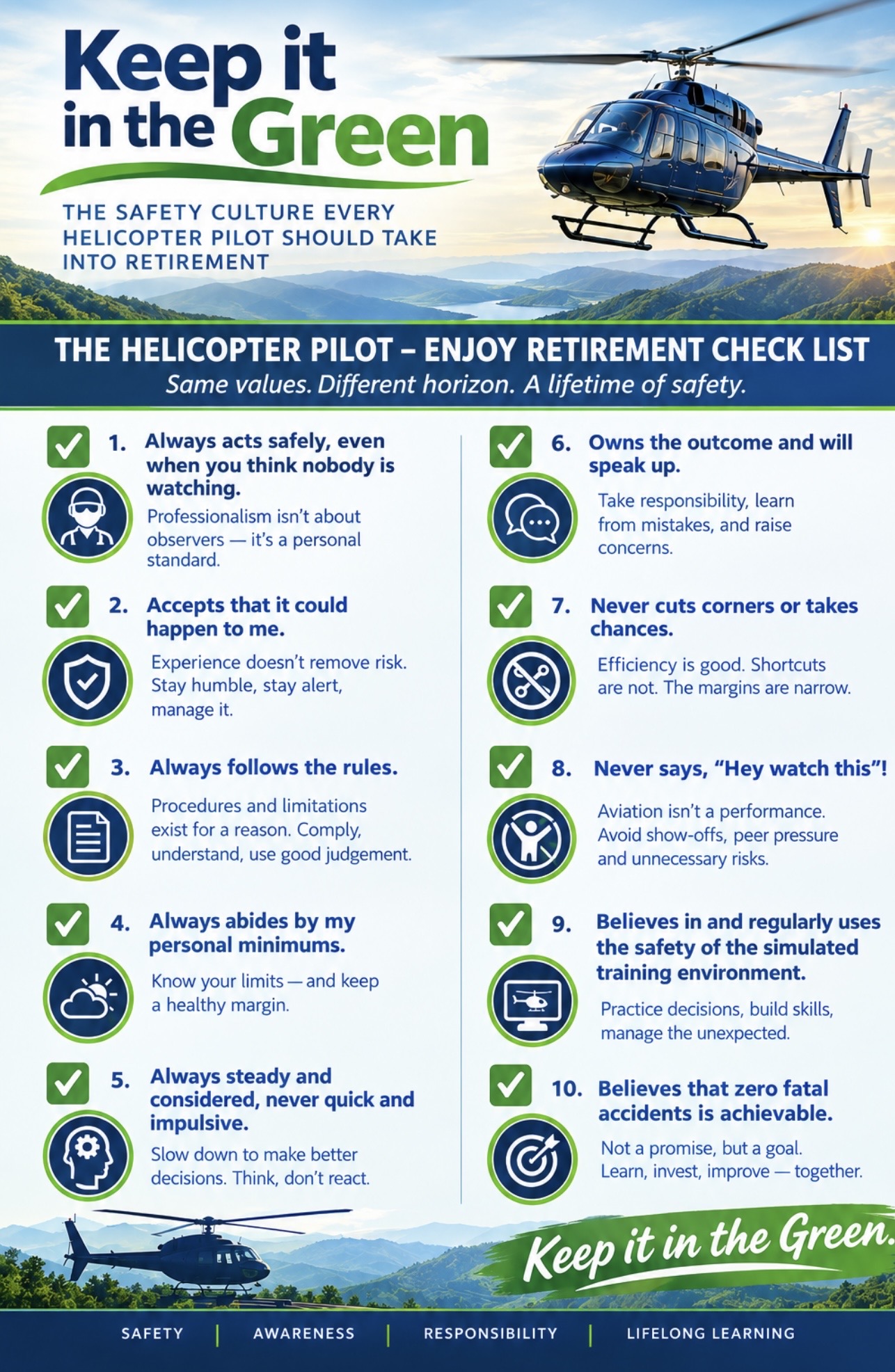
The Helicopter Pilot – Enjoy Retirement Check List, masterminded by Nick Mayhew when he was the Industry Co-Chair of the United States Helicopter Safety Team (USHST), and his “Keep It in the Green” message capture this philosophy in a series of straightforward statements. Although presented with retirement in mind, the lessons reach far beyond a flying career. They reflect the behaviors that underpin a strong safety culture throughout aviation.
Safety culture is often discussed in terms of organizational policies, reporting systems, standard operating procedures, and management commitments. All are important. Yet culture ultimately becomes visible through the everyday decisions people make, especially when nobody appears to be watching.
The checklist offers a useful reminder that a pilot's professional responsibility does not end with the last flight. The principles that prevent accidents can continue to influence how we live, work, and support the aviation community long after we leave the cockpit.
1. Always Acts Safely, Even When You Think Nobody Is Watching
Professionalism is most clearly demonstrated when external supervision disappears. A pilot who follows safe practices only during checks, assessments, or line operations has not fully embraced safety as a personal value.
The same principle applies to maintenance personnel, instructors, engineers, and managers. Every individual contributes to the safety system, and apparently minor shortcuts can become normalized if nobody challenges them.
A mature safety culture does not depend on someone looking over your shoulder. It depends on individuals recognizing that their actions have consequences for others. The standard we maintain in private should be the standard we expect of ourselves in public.
2. Accepts That It Could Happen to Me
Experience is invaluable in helicopter operations, but it can also create a dangerous illusion of immunity. A pilot who has completed thousands of hours without an accident may begin to believe that serious events happen to other people.
The reality is that experience does not eliminate exposure to risk. Weather changes, mechanical failures, human performance limitations, and unexpected situations can challenge even the most accomplished aviator.
Accepting personal vulnerability is not a sign of weakness. It is the foundation of sound risk management. It encourages pilots to recognize threats, question assumptions, and prepare for situations they hope never to encounter.
The strongest safety cultures make it acceptable to acknowledge uncertainty. They replace complacency with informed confidence and encourage continuous learning, regardless of rank, experience, or reputation.
3. Always Follows the Rules
Rules, procedures, and limitations are established for reasons that often emerge from hard-earned operational experience. They provide a common framework for decision-making and help prevent individual preferences from undermining collective safety.
However, following rules should involve more than mechanical compliance. Pilots must understand the intent behind procedures, recognize when circumstances are changing, and seek appropriate guidance when faced with uncertainty.
Aviation also requires judgment. Procedures cannot anticipate every conceivable situation, and safe decision-making sometimes demands a carefully considered response within the applicable operational and regulatory framework.
A healthy safety culture, therefore, combines disciplined compliance with professional understanding. It neither encourages casual deviation nor confuses unquestioning obedience with expertise.
4. Always Abides by My Personal Minimums
Personal minimums provide an important additional layer of protection. They reflect an individual's experience, proficiency, currency, fatigue, health, and confidence, alongside the conditions expected on a particular flight.
A legal flight is not automatically a sensible flight. Weather may be technically within the aircraft's or pilot's limits while still leaving insufficient margin for changing conditions, unfamiliar terrain, or deteriorating visibility.
Personal minimums are most effective when established before pressure enters the decision. Once passengers are waiting, a schedule is slipping, or expectations are mounting, the temptation to relax standards can become powerful.
So, don't modify your minimums halfway through an operation or flight—they are there to protect you and your passengers.
Pilots should periodically review their minimums and adjust them as circumstances change. The objective is not to demonstrate capability at the edge of the envelope, but to preserve sufficient margin to manage the unexpected.
5. Always Steady and Considered, Never Quick and Impulsive
Helicopter operations can demand rapid responses, but speed of action must not be confused with impulsiveness. Effective decision-making depends on recognizing what requires immediate intervention and what benefits from a moment of structured thought.
Terms like “quick stop” and “throttle chop” imply quick action. You rarely need to fly a “quick stop” quickly, and replacing terms like “chop the throttle” with “reduce the throttle” could help keep that aspirated engine running for you when you need it.
Under pressure, people can fixate on a problem, overlook alternatives, or allow emotion to influence judgment. Training, briefings, and rehearsed procedures help build the discipline needed to manage these tendencies.
A steady, considered approach also means recognizing when a situation is developing beyond one's capacity to manage it safely. Early intervention, a timely diversion, a rejected takeoff, or a decision not to depart may prevent a manageable threat from becoming an emergency.
The best decisions are not necessarily the most dramatic. Often, they are the quiet decisions that keep an uneventful flight uneventful.
6. Owns the Outcome and Will Speak Up
Accountability is essential to a strong safety culture, but it must not be confused with assigning blame whenever something goes wrong. Owning the outcome means recognizing one's responsibilities, acknowledging mistakes, and taking action to prevent recurrence.
It also means having the courage to raise concerns when a colleague, supervisor, or organizational practice appears to compromise safety.
Speaking up can be difficult, particularly where hierarchy, commercial pressure, or established habits discourage challenges. Effective organizations make it clear that respectful questioning is a professional obligation, not an act of disloyalty.
Safety improves when people can report hazards, challenge unsafe decisions, and share lessons without fear of unfair punishment. Accountability and psychological safety are complementary: people should be expected to act responsibly and supported when they raise genuine concerns.
7. Never Cuts Corners or Takes Chances
Shortcuts often begin with seemingly reasonable explanations: the task will take only a moment, the risk is familiar, or the procedure has always been done differently.
The danger is that repeated success can reinforce unsafe behavior. When a shortcut produces no immediate harm, it may gradually become accepted practice.
In helicopter operations, margins can be narrow. A small compromise in preparation, maintenance, weather assessment, or operational discipline may combine with other factors to produce an accident.
A robust safety culture challenges this gradual normalization of risk. It recognizes that efficiency must never be achieved by quietly removing essential safeguards.
8. Never Says, “Hey, Watch This!”
This simple statement captures an important truth about risk-taking: aviation skill should never become a performance for an audience.
Showing off, accepting unnecessary challenges, or attempting maneuvers beyond appropriate operational limits can turn confidence into recklessness. Peer pressure and the desire to demonstrate competence may be particularly influential among experienced pilots who feel they have little left to prove.
True professionalism is not about impressing observers. It is about demonstrating sound judgment, respecting limitations, and making decisions that protect everyone involved.
The experienced aviator knows that there is no shame in declining an unnecessary risk. Restraint is a skill, too.
9. Believes in and Regularly Uses the Ultimate Safety of the Simulated Training Environment
Simulation provides a valuable opportunity to practice aeronautical decision-making (ADM), rehearse abnormal and emergency procedures, and explore challenging scenarios without exposing people or aircraft to the corresponding real-world hazards.
Its value, however, depends on purposeful training. A simulator session should not simply reproduce familiar flights or become an exercise in demonstrating technical proficiency. It should challenge pilots to recognize developing threats, manage workload, communicate effectively, and make sound decisions under pressure.
Well-designed scenarios using all levels of simulator devices, including full-motion devices with both existing large-screen and cutting-edge virtual reality (VR) visual systems, also help crews examine mistakes, understand human performance limitations, and develop effective responses to rare but consequential events.
It should also be noted that you don't need to have seen every scenario to learn how to make good decisions. ADM is a process that can be instilled through well-structured simulation training.
Simulation cannot eliminate operational risk, and its benefits depend on appropriate fidelity, instructional quality, and the transfer of learning to real-world operations. Used thoughtfully, it is one of aviation's most powerful tools for building resilience.
10. Believes That Zero Fatal Accidents Is Achievable
The final statement is perhaps the most challenging. Can aviation genuinely aspire to zero fatal accidents when operations involve complex machines, unpredictable environments, and human limitations?
The aspiration should not be interpreted as a promise that risk can be eliminated or that every accident is preventable with certainty. Rather, it establishes a clear direction: every fatal accident must be treated as a tragedy worthy of investigation, learning, and renewed effort.
A zero-fatality ambition of “believe it to achieve it” encourages organizations to question accepted assumptions, invest in effective training, improve equipment and procedures, and share safety information across the industry.
It also demands humility: today's best practices must remain open to challenge as new evidence emerges.
Progress depends on collective responsibility. Pilots, operators, manufacturers, maintenance teams, regulators, and training organizations all have a part to play.
Conclusion: Retirement Is No Reason to Retire Your Safety Culture
The Helicopter Pilot – Enjoy Retirement Check List is more than a collection of reminders for life after flying. It is a concise statement of the behaviors that sustain professional aviation safety: personal responsibility, disciplined judgment, respect for limitations, openness to challenge, and a commitment to learning.
Retirement may bring freedom from operational schedules, recurrent checks, and the pressures of flight. It does not diminish the value of the experience accumulated over a career.
Retired pilots can continue to mentor younger aviators, support safety initiatives, share lessons from experience, and challenge the casual acceptance of unnecessary risk. Their contribution may be less visible than it was in the cockpit, but it can remain influential.
Ultimately, a strong safety culture is not defined by the posters on a hangar wall or the words in an operations manual. It is defined by what people consistently do, what they refuse to compromise, and whether they are prepared to speak when something is not right.
The checklist's closing message says it best: Keep It in the Green. Make safe decisions, protect your margins, keep learning, and help ensure that every flight ends as intended—with everyone returning home.
Because the best measure of a successful aviation career is not simply how many hours have been flown, but how many people have been kept safe along the way.
NMM, Oct. 2026