By Christian Custode
I was halfway through clearing out a drawer when an old notebook fell open on my desk.
Most of its pages were filled with calculations. There were arrows pointing to other arrows, numbers crossed out, and reminders squeezed into whatever space remained. Near the bottom of one page, I had written:
Check this again before the meeting.
I had underlined it twice.
I almost put the notebook in the pile to throw away. Then I started reading.
The notes came from an early project in my career. I remembered the work, but I had forgotten how much effort it had taken me to understand things that now seemed familiar. There were questions in those margins that I could answer in a few minutes today. Back then, I had needed hours.
That was what made me pull up a chair.
Until that moment, it had been an ordinary, frustrating week. Several things were unfinished. There was something else I wanted to study, another professional goal taking longer than I hoped, and another reason to feel that I should be further along.
And there, open on my desk, was a younger version of me who would have had a very different opinion.
In those early years, I believed that being prepared meant having every number ready.
Before a meeting, I would check the calculations, review the assumptions, and think through the questions someone might ask. If I worked carefully enough, I thought, I could make sure nothing caught me off guard.
Then someone asked a question that none of my notes could answer for me.
“What do you think we should do?”
I started explaining the figures.
“I understand the figures,” he said. “What would you recommend?”
I looked back at the page.
There was a strange comfort in the numbers. I could show where they came from. I could explain a formula. Making a recommendation meant putting my judgment beside them and accepting that someone might disagree.
What stays with me is the pause—and the realization that there was a part of the job I could only learn by doing it.
So I began learning it.
One recommendation at a time. One difficult question at a time. Sometimes by explaining my reasoning well. Sometimes by leaving a meeting and realizing how I could have explained it better.
There was plenty of checking again before the next one.
My career eventually took me from Latin America to the United States, and from projects worth a few million dollars to supporting decisions involving investments of more than $200 million.
There were new teams, new expectations, and another language in which to make myself understood. Experience helped. So did being willing to ask questions after I had already spent years in the profession.
Looking through that notebook, I could see how much of the earlier work had traveled with me.
The habit of questioning an assumption. The patience to understand why a result looked wrong. The care behind a recommendation that other people would use.
I had carried those habits into larger responsibilities so gradually that I had stopped noticing them.
Meanwhile, I had become very good at noticing whatever I had yet to accomplish.
There was always something ahead of me. I rarely turned around.
A few pages later, I found a question written beside an unfinished calculation. I could almost remember the frustration behind it.
It reminded me of the way people sometimes apologize before asking for help.
“This is probably a basic question.”
I understood that apology. I had made it myself.
But seeing my own questions on paper made me think about what happens when we become experienced. We forget how many explanations we needed. We remember knowing something and lose track of the long stretch when we did not.
I wanted to hold on to that stretch.
It is part of what gives sharing knowledge its value. When I wrote and published my book on mindset, planning, and entrepreneurship, I was putting lessons into words that someone else could use. My involvement with the American Solar Energy Society and my interest in community solar have also given me opportunities to bring what I know into conversations where I still have much to learn.
I like that combination: having something to contribute and still being changed by the work.
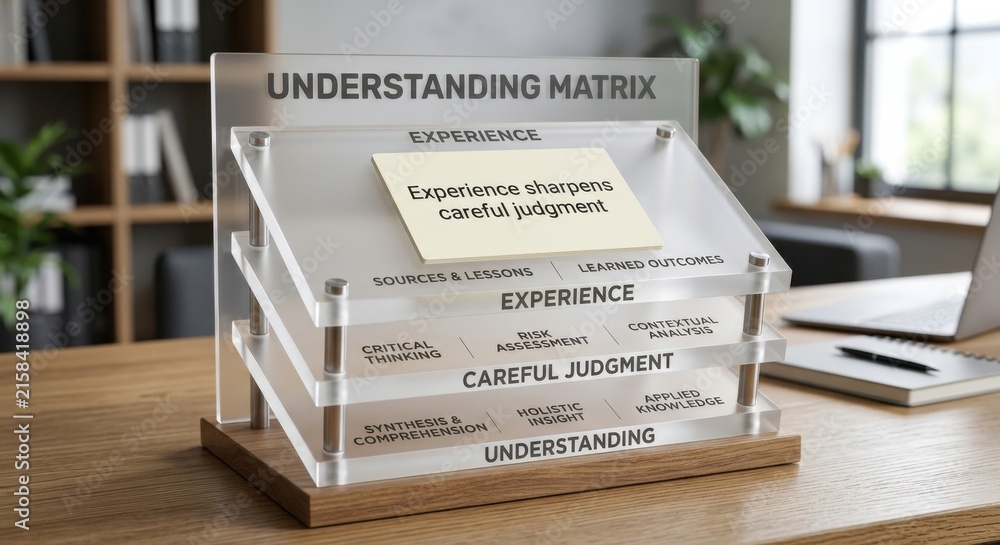
Looking back, I can see a progression that was difficult to notice while it was happening. Each project helped me develop judgment I would need in the next one: understanding the assumptions, asking better questions, and turning analysis into a recommendation others could act on.
That is a useful way to assess professional development. Alongside the next title or opportunity, consider the problems you are now equipped to solve. What can you explain more clearly? Which responsibilities can you handle with greater independence? Where can your experience help a team make a better decision? Those are concrete signs of progress, and they help identify what to learn next.
My work continues to evolve across investment decisions, energy, and the sharing of knowledge. The principle I carry forward is straightforward: keep learning, put that learning to work, and make it useful to others.
Experience earns its value in the next decision we help improve.