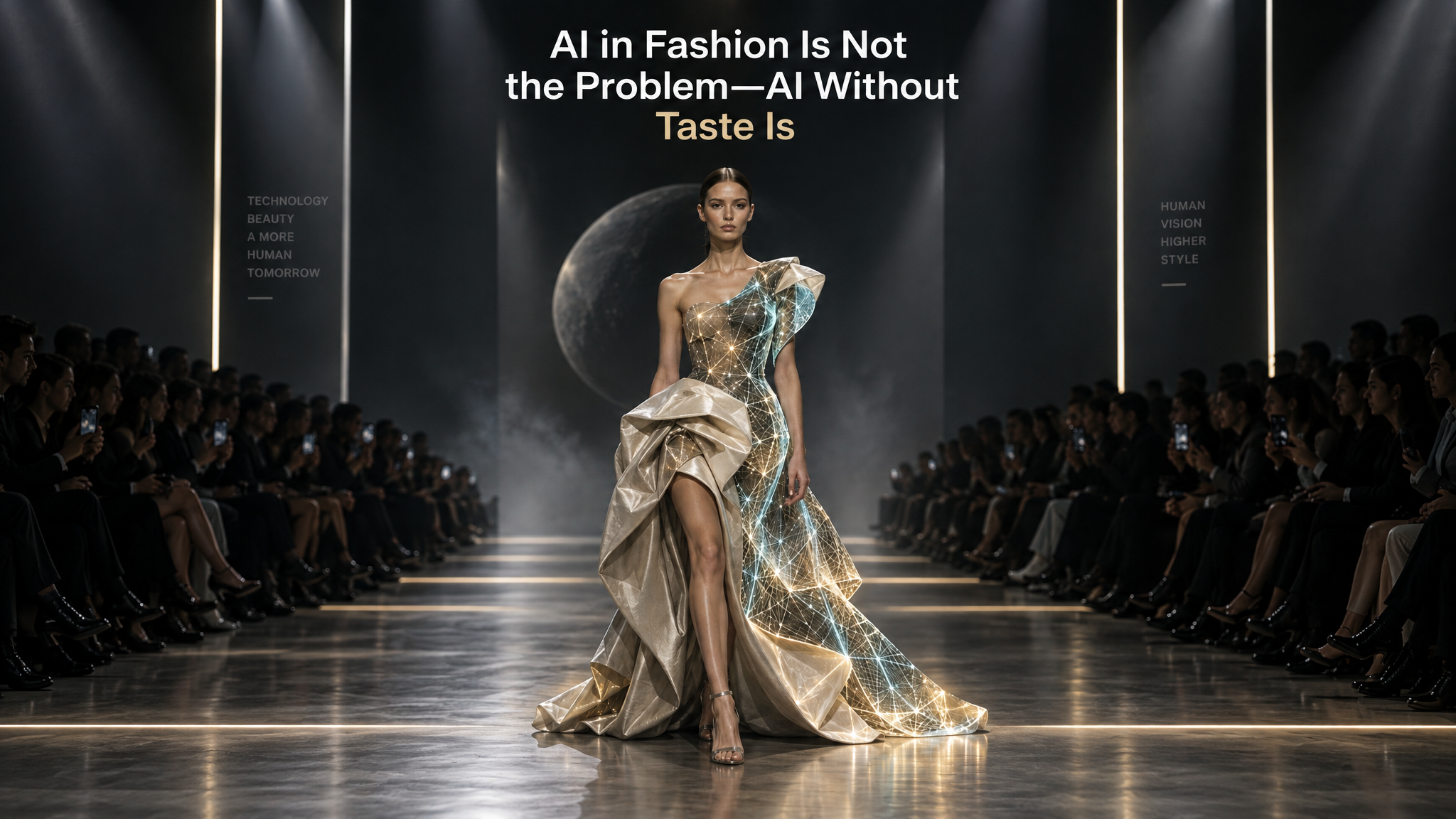
Fashion has always embraced new technology. Photography revolutionized fashion advertising. Digital retouching changed how campaigns were made. E-commerce changed the experience of collections for the customer. Social media changed the speed at which brands had to create and disseminate visual content.
And now, artificial intelligence is evolving again. It can produce models, environments, campaign concepts, product variations, and moving images in a fraction of the time of traditional production.
But the real issue is not the technology itself.
The real question is what happens when this powerful technology is used without taste, without direction, and without responsibility.
The Reaction Is Understandable
Much of the criticism around AI in fashion is valid. People fret about the use of models’ likenesses without consent, the displacement of creative professionals, uncertainty around copyright, misleading advertising, and the deluge of low-quality images that all start to look the same.
Such concerns should not be dismissed as resistance to progress. Fashion is about people. It’s dependent on designers, stylists, photographers, models, makeup artists, editors, producers, and creative directors who know more than just how to do things. They understand mood, culture, proportion, aspiration, and the emotional reasons why people connect to a brand.
When AI is used as a shortcut to those disciplines, the result is often obvious. The image might be technically impressive, but the garment feels wrong, the pose is pointless, the lighting is not cohesive, or the whole campaign feels disconnected from the brand.
It is not a lack of imagination. It’s a failure of direction.
Speed Is Not the Same Thing as Quality
With AI, you can produce hundreds of visuals in a flash. That’s not to say that hundreds of useful options haven’t been created.
The fashion team still has to choose what concept supports the collection, what model feels right for the customer, what setting reinforces the brand, and what images should go public. Someone has to check the details of the clothing, the anatomy, the hands, the movement, the shadows, the props, the logos, and the continuity from one frame to another.
Producing is only one step in the process. What survives the process is determined by taste.
That distinction matters because brands don’t need more images simply because more images are possible. They need visual assets that communicate a specific identity and serve a specific purpose—introducing a collection, supporting a launch, creating social content, testing a campaign direction, or extending an existing production into new formats.
AI Should Open Up Creative Possibilities
The best use of AI in fashion isn’t to replace all traditional production. It opens up the range of ideas a creative team can play with.
A brand may want to test out a surreal environment before building it physically. A marketing team may require several short-form versions for a launch. An agency might want to show a client a few different visual directions before suggesting a larger production. A designer may wish to study the behavior of a collection in a world that would be too expensive or impractical to build.
These are meaningful use cases because the technology solves a real production or creative problem.
Traditional film and photography will remain important for many campaigns. There are things that real materials, physical movement, human chemistry, and the vagaries of a live set can never replace. In other cases, digital production can offer speed, flexibility, and experimentation without requiring an entire physical shoot for every variation.
The future will not be only physical or only digital. It's going to be increasingly hybrid.
Four Standards for Responsible Fashion AI Production
1. Begin With the Brand, Not the Tool
The creative brief should precede the prompt. Before creating anything, a team should know the company's visual language, customer, product, history, and objective.
2. Let a Human Be in Charge of the Outcome
AI does not take the blame when a logo is wrong, a garment is unusable, or an image is misleading. Somebody needs to handle the work, check the output, and sign off on the deliverables.
3. Production Includes Rights and Permissions
Teams need to understand how digital models are made, whether a real person’s image is used, what rights apply to that use, and where the final assets can be published. Legal and ethical issues should be resolved before the campaign goes live.
4. Assess the Work Using Fashion Standards
The last question is not whether an image is AI-generated. The questions are: Does it accurately convey the collection? Does it feel intentional? Does it meet the standard the brand claims to represent?
The Edge Will Go to the Disciplined Creatives
AI won’t make every fashion brand creative. It will make disciplined creative teams more experimental and more rapid.
The teams that win the most aren’t the teams that create the most content. They will be the ones who can differentiate an interesting experiment from a finished brand asset.
That requires more than just access to software. It takes an eye, experience in production, technical review, respect for rights, and a willingness to turn down work that isn’t good enough.
This is the distinction we at Noir Starr Models are trying to maintain. We are a human-led creative team that uses digital and AI-assisted production. Our goal is not to make generic images en masse. We want to create fashion assets that have a point of view, a purpose, and a polish that earns them a spot in a brand’s visual landscape.
The technology is going to get better. That should raise the standards.
Anthony Starr is the founder of Noir Starr Models, a human-led digital fashion production agency.